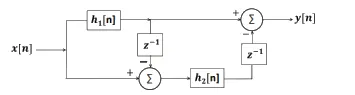
Consider the discrete time system (S) with input x[n] and output y[n] as shown in the Figure. The two sub-systems represented by their impulse responses h1[n] and h2[n] are linear and time invariant. Which of the following statements is necessarily TRUE?
Correct Answer :
S is linear and time invariant.
Solution :
The correct answer is: S is linear and time invariant.
To determine the properties of the overall discrete-time system (S), we can analyze the components and their connections as shown in the diagram.
1. Analysis of System Components:
According to the given information and the block diagram:
- The sub-systems with impulse responses and are linear and time-invariant (LTI) systems.
- The delay elements represented by the transfer function introduce a shift in time, which is a linear and time-invariant operation.
- The summation blocks (indicated by the circles with and sign labels "+" or "-") perform addition and subtraction, which are linear and time-invariant operations.
2. Mathematical Formulation:
Let us trace the signals through each branch of the system:
Let be the output of the sub-system :
The signal going through the first delay block becomes . At the bottom-left adder, the input signal is added to the negative of this delayed signal, producing:
This combined signal then passes through the sub-system , giving:
This output is then delayed by the second delay element to yield . Finally, at the top-right summation block, the overall output is formed by subtracting this delayed signal from :
3. Conclusion of Linearity and Time-Invariance:
Since every individual component in the diagram is linear and time-invariant, and the overall system is constructed solely using connections of these components (parallel branches, cascades, additions, and subtractions), the combined system is guaranteed to be linear and time-invariant.
4. Why Other Statements Are Not Necessarily True:
- Causality: The question states only that the sub-systems are linear and time-invariant. It does not state that the impulse responses and are causal. If either of these sub-systems is non-causal (i.e., depends on future inputs), the overall system (S) will also be non-causal. Therefore, we cannot conclude that S is necessarily causal.
Access expert-curated educational resources and study materials—completely free.
Create, conduct, and manage professional online assessments with Mindyard. Perfect for teachers and institutes.
Copyright © 2026 Mindyard. All Rights Reserved.