Consider the following figures A and B:
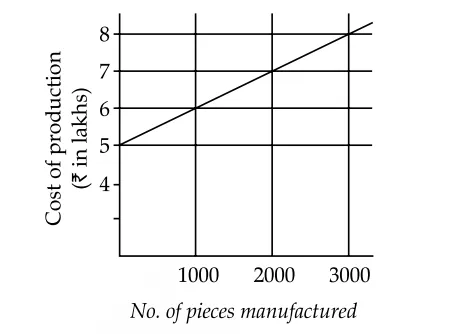
Fig. A
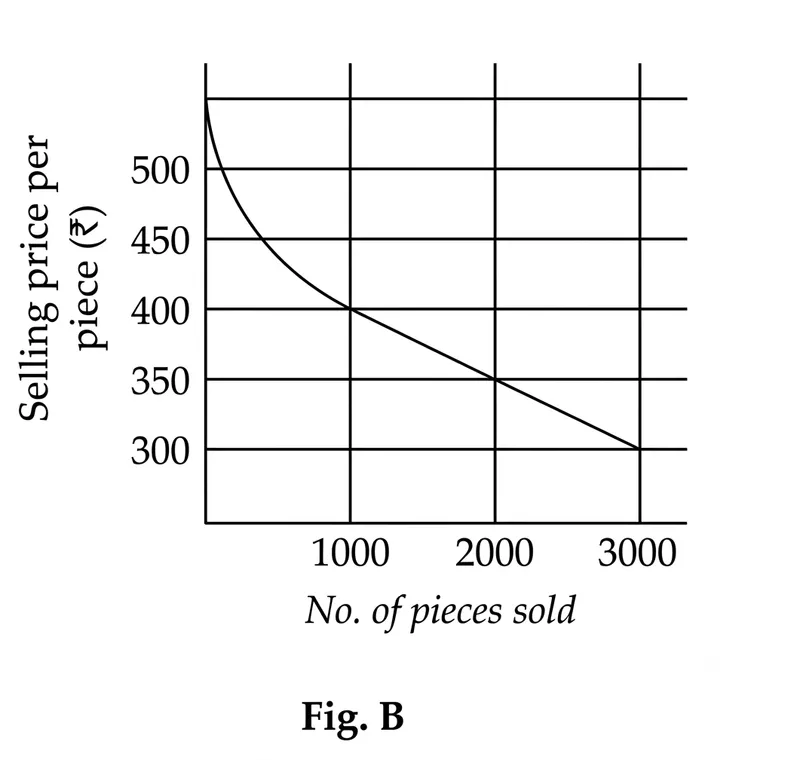
Fig. B
The manufacturing cost and projected sales for a product are shown in the above figures A and B respectively. What is the minimum number of pieces that should be manufactured to avoid a loss?
Correct Answer :
2000
Solution :
The correct option is 2000.
To determine the minimum number of pieces that must be manufactured to avoid a loss (the break-even point), we need to compare the total manufacturing cost with the total sales revenue generated at different quantities.
Step 1: Analyze Figure A (Cost of Production)
Figure A shows the total cost of production (in lakhs of Rupees, ₹) plotted against the number of pieces manufactured:
- At 0 pieces, the cost is ₹ 5 lakhs (which represents the fixed setup cost).
- At 1000 pieces, the cost is ₹ 6 lakhs.
- At 2000 pieces, the cost is ₹ 7 lakhs (₹ 7,00,000).
- At 3000 pieces, the cost is ₹ 8 lakhs.
We can write the cost function as a linear equation. Let represent the number of pieces manufactured. Since the cost increases by ₹ 1 lakh (₹ 1,00,000) for every 1000 pieces, the variable cost per piece is:
Therefore, the total cost function is:
Step 2: Analyze Figure B (Selling Price per Piece)
Figure B shows the selling price per piece (in ₹) as a function of the number of pieces sold:
- For 1000 pieces, the selling price per piece is ₹ 400.
- For 2000 pieces, the selling price per piece is ₹ 350.
- For 3000 pieces, the selling price per piece is ₹ 300.
Step 3: Calculate Total Revenue and Compare with Production Cost
Let us evaluate the total cost and total revenue for the different quantities shown in the graphs:
Case 1: Quantity () = 1000 pieces
- Total Cost: (₹ 6 lakhs)
- Selling Price per piece: ₹ 400
- Total Revenue: (₹ 4 lakhs)
Since Revenue < Cost, manufacturing 1000 pieces results in a loss of ₹ 2,00,000.
Case 2: Quantity () = 2000 pieces
- Total Cost: (₹ 7 lakhs)
- Selling Price per piece: ₹ 350
- Total Revenue: (₹ 7 lakhs)
Here, Total Revenue = Total Cost. There is neither a profit nor a loss (break-even point).
Case 3: Quantity () = 3000 pieces
- Total Cost: (₹ 8 lakhs)
- Selling Price per piece: ₹ 300
- Total Revenue: (₹ 9 lakhs)
Here, Revenue > Cost, resulting in a profit of ₹ 1,00,000.
Thus, to avoid any loss, the manufacturer needs to break even, which is achieved at a minimum of 2000 pieces.
Access expert-curated educational resources and study materials—completely free.
Create, conduct, and manage professional online assessments with Mindyard. Perfect for teachers and institutes.
Copyright © 2026 Mindyard. All Rights Reserved.