Consider the following reaction:
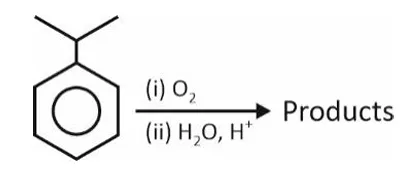
Products obtained are:
Options
Correct Answer :
Solution :
The reaction shown in the image represents the industrial preparation of phenol, widely known as the Cumene Process.
Let us analyze the reaction step-by-step:
Step 1: Oxidation of Cumene
The starting material shown in Image 0 is cumene (isopropylbenzene), which consists of a benzene ring bonded to an isopropyl group, -CH(CH3)2.
When cumene is oxidized in the presence of oxygen (), the tertiary C-H bond of the isopropyl group (which is benzylic and relatively weak) is cleaved to form a stable tertiary benzylic radical. Reaction with oxygen produces cumene hydroperoxide:
Step 2: Acid-Catalyzed Hydrolysis and Rearrangement
In the second step, cumene hydroperoxide is treated with dilute aqueous acid ().
Protonation of the terminal oxygen atom of the hydroperoxide group followed by the loss of a water molecule initiates a rearrangement. The phenyl group migrates from the benzylic carbon to the electron-deficient oxygen atom. Subsequent nucleophilic attack by water and proton transfers yield two major products:
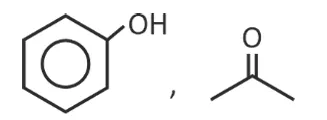
1. Phenol () - a benzene ring directly attached to a hydroxyl group.
2. Acetone () - a key byproduct.
Comparing this with the options provided in the images:
- Option 1 (Image 1) shows the structures of phenol (a benzene ring with an -OH group) and acetone (propan-2-one).
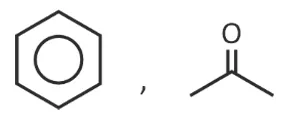
- Option 2 (Image 2) shows benzene and acetone.
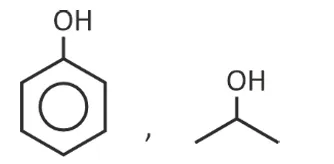
- Option 3 (Image 3) shows phenol and propan-2-ol.
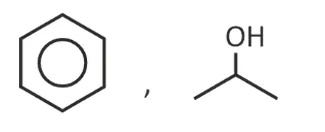
- Option 4 (Image 4) shows benzene and propan-2-ol.
Therefore, the correct products obtained are phenol and acetone, as represented in the first option.
Access expert-curated educational resources and study materials—completely free.
Create, conduct, and manage professional online assessments with Mindyard. Perfect for teachers and institutes.
Copyright © 2026 Mindyard. All Rights Reserved.