
Consider the following reaction sequence in which J, K, L and M are the major products.
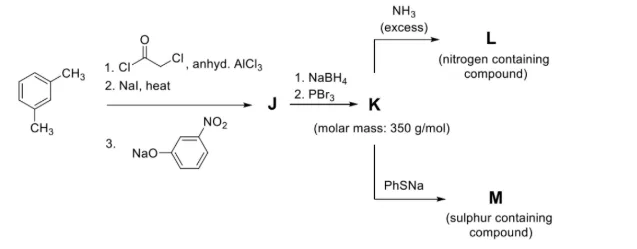
Given:
Atomic mass (in amu): H : 1, C : 12, N : 14, O : 16, S : 32, Br : 80, Ba : 137
The volume of 1 M aqueous H2SO4 required to completely neutralize the ammonia evolved from 5.72 g of L in Kjeldahl’s method of nitrogen estimation is _____ mL.
Correct Answer :
Solution :
The correct answer is 20 (or 20 mL).
Step 1: Determine the structures of J, K, and L from the given reaction sequence:
1. Formation of J:
Starting material is m-xylene (1,3-dimethylbenzene).
- Step 1: Friedel-Crafts acylation with 2-chloroacetyl chloride (Cl-CH2-CO-Cl) in the presence of anhydrous AlCl3 inserts an acyl group (-CO-CH2-Cl) onto the aromatic ring (electrophilic substitution at the position ortho to one methyl and para to the other, position 4 of 1,3-dimethylbenzene).
- Step 2: Finkelstein reaction with NaI replaces -Cl with -I to form -CO-CH2-I.
- Step 3: Nucleophilic substitution with sodium 3-nitrophenoxide (3-O2N-C6H4-ONa) replaces -I with the phenoxy group -O-C6H4-3-NO2.
Thus, J is 2-(3-nitrophenoxy)-1-(2,4-dimethylphenyl)ethan-1-one.
2. Formation of K:
- Step 1: Reduction of the carbonyl group in J using NaBH4 yields the secondary alcohol (-CH(OH)-CH2-O-C6H4-3-NO2).
- Step 2: Reaction with PBr3 replaces the hydroxyl group (-OH) with a bromine atom (-Br).
Thus, K is 4-(1-bromo-2-(3-nitrophenoxy)ethyl)-1,3-dimethylbenzene.
- Chemical Formula of K: C16H16BrNO3
- Molar mass of K = 16(12) + 16(1) + 80 + 14 + 3(16) = 192 + 16 + 80 + 14 + 48 = 350 g/mol (which matches the value given in the diagram).
3. Formation of L:
- Reaction of K with excess ammonia (NH3) undergoes nucleophilic substitution where the bromine atom (-Br) is replaced by an amino group (-NH2).
Thus, L is 2-(2,4-dimethylphenyl)-2-(3-nitrophenoxy)ethan-1-amine (or its isomer having -NH2 group replacing -Br).
- Chemical Formula of L: C16H18N2O3
- Molar Mass of L = 16(12) + 18(1) + 2(14) + 3(16) = 192 + 18 + 28 + 48 = 286 g/mol.
Step 2: Kjeldahl's method and Stoichiometry:
Each molecule of L contains 2 nitrogen atoms (one from the nitro group and one from the amine group). In standard Kjeldahl's method, nitrogen in organic compounds is converted quantitatively into ammonia gas (NH3).
Therefore, 1 mole of compound L yields 2 moles of NH3.
Moles of compound L in 5.72 g:
Moles of NH3 evolved:
Step 3: Neutralization with H2SO4:
The neutralization reaction of ammonia with sulfuric acid is:
From the reaction stoichiometry, 2 moles of NH3 require 1 mole of H2SO4 for complete neutralization.
Given the concentration of H2SO4 solution is 1 M:
Converting the volume into mL:
Access expert-curated educational resources and study materials—completely free.
Create, conduct, and manage professional online assessments with Mindyard. Perfect for teachers and institutes.
Copyright © 2026 Mindyard. All Rights Reserved.




