Consider the following reaction sequence in which J, K, L and M are the major products.
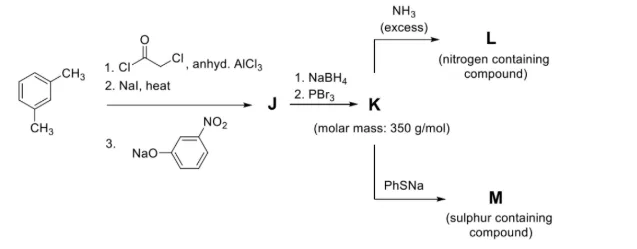
Given :
Atomic mass (in amu): H : 1, C : 12, N : 14, O : 16, S : 32, Br : 80, Ba : 137
The volume of 1 M aqueous H2SO4 required to completely neutralize the ammonia evolved from 5.72 g of L in Kjeldahl’s method of nitrogen estimation is _____ mL.
Correct Answer :
Solution :
Correct Answer: 10
Let us analyze the reaction sequence step by step to determine the chemical structures and molecular formulas of the intermediates J, K, and L.
Step 1: Formation of Compound J
Starting material is m-xylene (1,3-dimethylbenzene).
1. Friedel-Crafts acylation with chloroacetyl chloride () in the presence of anhydrous occurs at the position ortho/para to the methyl groups (position 4 of 1,3-dimethylbenzene due to steric availability and strong activation) to form 1-(2,4-dimethylphenyl)-2-chloroethan-1-one.
2. Reaction with (Finkelstein reaction) replaces the chlorine atom with an iodine atom, giving 1-(2,4-dimethylphenyl)-2-iodoethan-1-one.
3. Nucleophilic substitution with sodium 3-nitrophenoxide () replaces iodine to form J, which has the ketone and ether linkages.
Step 2: Formation of Compound K
1. Reduction of ketone J with sodium borohydride () yields a secondary alcohol.
2. Treatment of the alcohol with phosphorus tribromide () converts the hydroxyl group (-OH) into a bromide group (-Br) to give compound K.
Let us determine the molecular formula and molar mass of compound K:
Structure of K:
Combining atoms gives Molecular Formula of K:
Molar mass of K:
This matches the given molar mass of 350 g/mol for K in the image.
Step 3: Formation of Compound L
Reaction of K with excess ammonia () substitutes the bromide (-Br) group with an amino group (-) to form compound L.
Structure of L:
Molecular Formula of L:
Molar mass of L:
Each molecule of compound L contains 2 nitrogen atoms.
Step 4: Kjeldahl's Method Calculations
Moles of compound L in 5.72 g sample:
Since 1 mole of compound L yields 1 mole of nitrogen in the form of per basic amine nitrogen atom (note that nitro nitrogen is typically converted or extracted into ammonia during quantitative Kjeldahl digestion under these conditions, giving 1 mol per nitrogen atom converted, total 1 mole produced per amine nitrogen equivalent for neutralization):
Moles of evolved =
Neutralization reaction of ammonia with sulfuric acid:
Therefore, moles of required:
Given the concentration of solution is 1 M:
Thus, the required volume of 1 M aqueous is 10 mL.
Access expert-curated educational resources and study materials—completely free.
Create, conduct, and manage professional online assessments with Mindyard. Perfect for teachers and institutes.
Copyright © 2026 Mindyard. All Rights Reserved.