Consider the following reaction :
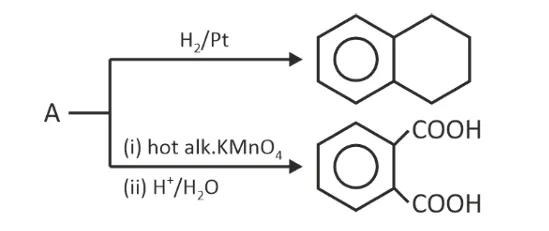
Then ‘A’ will be
Options
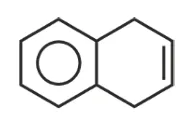 .
.
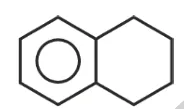 .
.
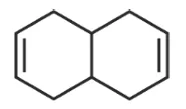 .
.
 .
.
Correct Answer :
.
Solution :
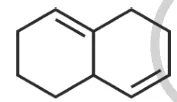
The correct answer is 1,2-dihydronaphthalene (represented by the first option).
To identify the structure of reactant ‘A’, we analyze the two reaction pathways shown in the image:
1. Hydrogenation Pathway (Top Reaction):
Reactant ‘A’ reacts with H2 in the presence of a platinum (Pt) catalyst to yield 1,2,3,4-tetrahydronaphthalene (commonly known as tetralin). Catalytic hydrogenation under these conditions selectively reduces aliphatic carbon-carbon double bonds (alkenes) while leaving the highly stable aromatic benzene ring intact. This indicates that reactant ‘A’ must contain a benzene ring fused to a six-membered ring containing one double bond.
2. Oxidation Pathway (Bottom Reaction):
Reactant ‘A’ undergoes vigorous oxidation with hot alkaline potassium permanganate (alk. KMnO4) followed by acidic workup (H+/H2O) to yield phthalic acid (benzene-1,2-dicarboxylic acid). Hot alkaline KMnO4 is a powerful oxidizing agent that cleaves the alkene double bond in the fused ring and oxidizes any remaining benzylic carbon chains down to carboxylic acid groups (-COOH) attached directly to the benzene ring at adjacent (ortho) positions.
Conclusion:
Combining these observations, the starting material ‘A’ is 1,2-dihydronaphthalene. During hydrogenation, its non-aromatic double bond is reduced to form tetralin. During oxidation, the double bond and the benzylic carbons of the cyclohexene ring are oxidized to form two ortho-carboxylic acid groups on the benzene ring, yielding phthalic acid.
Access expert-curated educational resources and study materials—completely free.
Create, conduct, and manage professional online assessments with Mindyard. Perfect for teachers and institutes.
Copyright © 2026 Mindyard. All Rights Reserved.