Consider the given data with frequency distribution
xi = 3, 8, 11, 10, 5, 4 fi = 5, 2, 3, 2, 4, 4
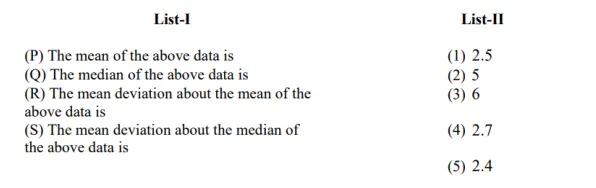
Match each entry in List-I to the correct entries in List-II.
Correct Answer :
(P ) → (3), (Q) → (2), (R) → (4), (S) → (5)
Solution :
The correct option is (P ) → (3), (Q) → (2), (R) → (4), (S) → (5).
Let us analyze the given frequency distribution table:
From the question, the given values of observations xi and their corresponding frequencies fi are:
Arranging the data in ascending order of xi along with their frequencies fi and cumulative frequencies c.f.:
• x1 = 3, f1 = 5, c.f. = 5
• x2 = 4, f2 = 4, c.f. = 9
• x3 = 5, f3 = 4, c.f. = 13
• x4 = 8, f4 = 2, c.f. = 15
• x5 = 10, f5 = 2, c.f. = 17
• x6 = 11, f6 = 3, c.f. = 20
Total frequency, .
Step 1: Calculate Mean () - Entry (P)
Sum of products is:
Therefore, the mean is:
Hence, (P) → (3).
Step 2: Calculate Median (M) - Entry (Q)
Since total frequency N = 20 (an even number), the median is the average of the (N/2)th and (N/2 + 1)th observations, which are the 10th and 11th observations.
Looking at the cumulative frequencies:
• Cumulative frequency up to x = 4 is 9.
• Cumulative frequency up to x = 5 is 13.
Thus, both the 10th and 11th observations lie in the group x = 5.
Hence, (Q) → (2).
Step 3: Calculate Mean Deviation about the Mean - Entry (R)
We calculate for each observation with :
• x = 3: |3 - 6| = 3, fi|xi - 6| = 5 × 3 = 15
• x = 4: |4 - 6| = 2, fi|xi - 6| = 4 × 2 = 8
• x = 5: |5 - 6| = 1, fi|xi - 6| = 4 × 1 = 4
• x = 8: |8 - 6| = 2, fi|xi - 6| = 2 × 2 = 4
• x = 10: |10 - 6| = 4, fi|xi - 6| = 2 × 4 = 8
• x = 11: |11 - 6| = 5, fi|xi - 6| = 3 × 5 = 15
Mean deviation about mean =
Hence, (R) → (4).
Step 4: Calculate Mean Deviation about the Median - Entry (S)
We calculate for each observation with M = 5:
• x = 3: |3 - 5| = 2, fi|xi - 5| = 5 × 2 = 10
• x = 4: |4 - 5| = 1, fi|xi - 5| = 4 × 1 = 4
• x = 5: |5 - 5| = 0, fi|xi - 5| = 4 × 0 = 0
• x = 8: |8 - 5| = 3, fi|xi - 5| = 2 × 3 = 6
• x = 10: |10 - 5| = 5, fi|xi - 5| = 2 × 5 = 10
• x = 11: |11 - 5| = 6, fi|xi - 5| = 3 × 6 = 18
Mean deviation about median =
Hence, (S) → (5).
Conclusion:
Matching the items from List-I to List-II:
(P) → (3)
(Q) → (2)
(R) → (4)
(S) → (5)
Access expert-curated educational resources and study materials—completely free.
Create, conduct, and manage professional online assessments with Mindyard. Perfect for teachers and institutes.
Copyright © 2026 Mindyard. All Rights Reserved.