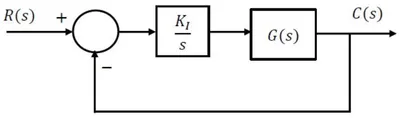
Consider the stable closed-loop system shown in the figure. The magnitude and phase values of the frequency response of G(s) are given in the table. The value of the gain KI(>0) for a 50° phase margin is __________ (rounded off to 2 decimal places).
| ω in rad/sec |
Magnitude in dB |
Phase in degrees |
| 0.5 |
-7 | -40 |
| 1.0 | -10 | -80 |
| 2.0 | -18 | -130 |
| 10.0 | -40 | -200 |
Correct Answer :
Solution :
The correct answer is 1.11.
Step-by-Step Explanation:
1. Understanding the Loop Transfer Function
From the given block diagram, we have a unity feedback closed-loop system where:
- The feedback path gain is
- The feedforward path consists of an integrator with gain block in series with the plant .
Therefore, the open-loop transfer function of the system is:
2. Frequency Response and Phase Relation
Substituting to obtain the frequency response:
Since , its phase angle is . The phase contribution of the integrator term in the denominator, , is . Thus, the phase angle of the open-loop transfer function is given by:
3. Determining the Gain Crossover Frequency ()
The Phase Margin (PM) of a system is defined at the gain crossover frequency as:
Given that the desired Phase Margin is , we substitute this value into the equation:
This gives the required phase of the open-loop system at crossover:
Now, substituting the phase relation from Step 2:
Looking at the provided frequency response table for :
- At , the phase of is exactly .
Thus, the gain crossover frequency is:
4. Calculating the gain
At the gain crossover frequency , the magnitude of the open-loop transfer function must be equal to (or ):
From the table, at , the magnitude of is . Let's convert this decibel value to absolute (linear) scale:
Using the linear magnitude, we solve for :
Rounding to two decimal places, we get:
Access expert-curated educational resources and study materials—completely free.
Create, conduct, and manage professional online assessments with Mindyard. Perfect for teachers and institutes.
Copyright © 2026 Mindyard. All Rights Reserved.