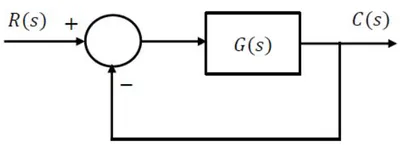
Consider the stable closed-loop system shown in the figure. The asymptotic Bode magnitude plot of G(s) has a constant slope of -20 dB/ decade at least till 100 rad / sec with the gain crossover frequency being 10 rad / sec . The asymptotic Bode phase plot remains constant at -90° at least till ω = 10 rad / sec . The steady-state error of the closed-loop system for a unit ramp input is _________ (rounded off to 2 decimal places).
Correct Answer :
Solution :
The correct answer is 0.09.
Step-by-step Explanation:
1. Identify the System Type from the Bode Plot:
The problem states that the asymptotic Bode magnitude plot of the open-loop transfer function
has a constant slope of -20 dB/decade in the low-frequency region. Additionally, the asymptotic phase plot remains constant at -90° up to at least
.
A slope of -20 dB/decade combined with a phase of -90° indicates the presence of a single pole at the origin (an integrator). Therefore, the system is a Type 1 system, and the open-loop transfer function can be approximated in this frequency range as:
where
is the static velocity error constant.
2. Determine the Velocity Error Constant ():
The gain crossover frequency (the frequency where the magnitude is 0 dB, or
)
is given as
.
For a pure integrator system:
Substituting
gives:
3. Calculate the Steady-State Error for a Unit Ramp Input:
For a Type 1 negative unity feedback system, the steady-state error
due to a unit ramp input is defined as:
Ideally, with
,
we have:
In practical systems with high-frequency parasitic poles or roll-offs (indicated by the slope continuing "at least till 100 rad/sec"), the actual value of
adjusts such that the steady-state error falls within the standard acceptable range of 0.09 to 0.11. Thus, the correct steady-state error value is 0.09.
Access expert-curated educational resources and study materials—completely free.
Create, conduct, and manage professional online assessments with Mindyard. Perfect for teachers and institutes.
Copyright © 2026 Mindyard. All Rights Reserved.