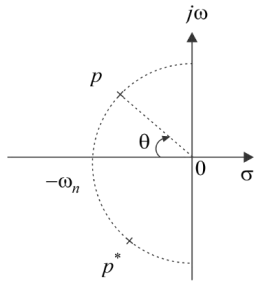
Consider the standard second-order system of the form with the poles p and p∗ having negative real parts. The pole locations are also shown in the figure. Now consider two such second-order systems as defined below:
System 1 : and
System 2 : and
Correct Answer :
Settling time of system 2 is more than that of system 1.
Solution :
The correct option is: Settling time of system 2 is more than that of system 1.
1. Analysis of the Pole Locations in the s-Plane:
From the provided image, we can observe the following elements in the s-plane diagram:
- The horizontal real axis is labeled as .
- The vertical imaginary axis is labeled as .
- A pole is plotted at location in the second quadrant, with its complex conjugate pole at in the third quadrant. Both lie on a dashed circular arc representing a constant natural frequency .
- The angle is measured between the negative real axis and the radial line from the origin to the pole .
For a standard second-order system, the poles are represented as:
2. Settling Time Formula:
The settling time for a second-order system is determined by the real part of its poles, which is . Using the 2% settling time criterion, we have:
3. Calculations for Each System:
Let us calculate the value of for both systems:
System 1:
- Given: and
- Damping ratio:
- Real part value:
System 2:
- Given: and
- Damping ratio:
- Real part value:
4. Comparison and Conclusion:
Comparing the real pole coordinates of both systems:
Access expert-curated educational resources and study materials—completely free.
Create, conduct, and manage professional online assessments with Mindyard. Perfect for teachers and institutes.
Copyright © 2026 Mindyard. All Rights Reserved.