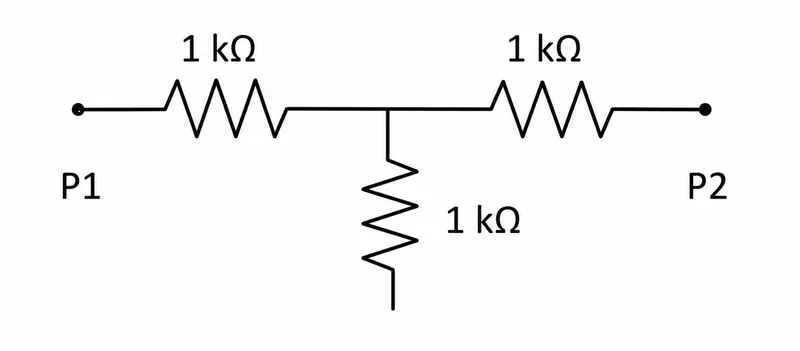
Consider the two-port network as shown in the Figure. Which of the following options provides the correct set of values of A, B, C and D parameters?
Correct Answer :
Solution :
The correct option is:
Step-by-Step Explanation:
1. Analysis of the Circuit Diagram:
From the given image, we observe a T-network representing the two-port network with Port 1 (P1) on the left and Port 2 (P2) on the right.
The values of the three resistors are:
2. Two-Port Network Definitions:
The transmission (ABCD) parameters of a two-port network relate the input variables (, ) to the output variables (, ) according to the following equations:
Here, is the current entering Port 1, and is the current entering Port 2. (Alternatively, if is defined as leaving Port 2, the minus signs become plus signs).
3. Calculating parameters A and C (Open-Circuit at Port 2):
We open-circuit Port 2, which means the current leaving Port 2 is zero, so .
Since Port 2 is open, no current flows through the right-arm resistor . The voltage at the output port, , is equal to the voltage across the shunt resistor .
Applying a voltage divider at Port 1:
Therefore, the parameter A is:
Next, the input current under this open-circuit condition flows entirely through and :
Therefore, the parameter C is:
4. Calculating parameters B and D (Short-Circuit at Port 2):
We short-circuit Port 2, meaning .
Let be the current flowing out of Port 2 under this condition. Since Port 2 is shorted, the resistors and are connected in parallel with respect to the node between them. Using current division:
Thus, the parameter D is:
To find B, we write the input voltage under this short-circuit condition. The total equivalent impedance seen from Port 1 is:
Hence, .
Since , we substitute to find in terms of :
Therefore, the parameter B is:
5. Summary of Parameter Values:
Collecting all the calculated transmission parameters, we obtain:
Access expert-curated educational resources and study materials—completely free.
Create, conduct, and manage professional online assessments with Mindyard. Perfect for teachers and institutes.
Copyright © 2026 Mindyard. All Rights Reserved.