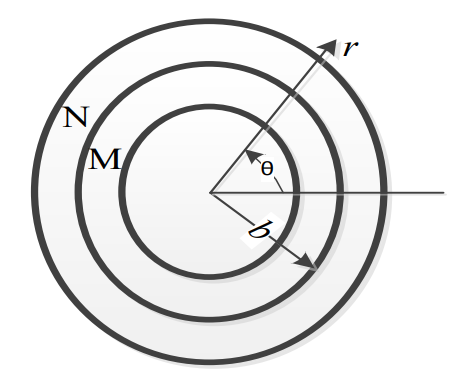
Consider two concentric circular cylinders of different materials M and N in contact with each other at r = b, as shown below. The interface at r = b is frictionless. The composite cylinder system is subjected to internal pressure P. Let (urM ,uθM) and (σrrM σθθM) denote the radial and tangential displacement and stress components, respectively, in material M. Similarly, (urN ,uθN) and (σrrN σθθN) denote the radial and tangential displacement and stress components, respectively, in material N. The boundary conditions that need to be satisfied at the frictionless interface between the two cylinders are :
Correct Answer :
urM = urN and σrrM= σrrN only
urM = urN and σrrM = σrrN only
Solution :
The correct answer is: urM = urN and σrrM = σrrN only
To determine the boundary conditions at the interface between the two concentric circular cylinders of different materials M and N, we analyze the physical contact conditions at the interface shown in the diagram:
1. Radial Displacement Continuity:
For the two cylinders to remain in contact without separating (gaps forming) or interpenetrating at the interface, the radial displacement of both materials at the contact surface must be equal. Therefore, we have:
2. Radial Stress Continuity:
By Newton's third law (action and reaction) and the equilibrium of a boundary element at the interface, the radial stress exerted by material M on material N must be equal to the radial stress exerted by material N on material M. Thus, the radial stress must be continuous across the interface:
3. Frictionless Interface Condition:
Since the interface at is frictionless, no shear stress can be transmitted across the boundary:
Because the interface is frictionless, the cylinders are free to slide relative to each other in the circumferential (tangential) direction. Thus, the tangential displacements do not need to be continuous:
4. Tangential (Hoop) Stress:
The tangential stress in each cylinder depends on the elastic properties (such as Young's modulus and Poisson's ratio) and the geometry of each respective material. Because these properties are different and there is no physical constraint requiring hoop stress to match at the boundary, we generally have:
Therefore, the only boundary conditions that must be satisfied at the frictionless interface are:
and only.
Access expert-curated educational resources and study materials—completely free.
Create, conduct, and manage professional online assessments with Mindyard. Perfect for teachers and institutes.
Copyright © 2026 Mindyard. All Rights Reserved.