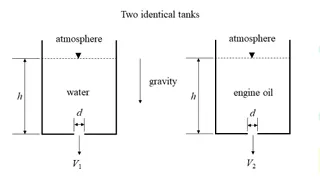
Consider two identical tanks with a bottom hole of diameter d. One tank is filled with water and the other tank is filled with engine oil. The height of the fluid column h is the same in both cases. The fluid exit velocity in the two tanks are V1 and V2. Neglecting all losses, which one of the following options is correct?
Correct Answer :
V2 = V1
Solution :
The correct option is: V2 = V1
Based on the provided diagram, we have two identical tanks under the influence of gravity (indicated by the downward arrow labeled "gravity"). Both tanks are open to the "atmosphere" at the top. The tank on the left is filled with "water" and the tank on the right is filled with "engine oil". Both fluids have the same column height h and exit through a bottom hole of diameter d. The fluid exit velocity of the water is V1, and the exit velocity of the engine oil is V2.
To find the exit velocity of a fluid from a tank while neglecting all losses (such as friction and viscosity), we apply Bernoulli's equation between the top free surface of the fluid (point 1) and the exit hole at the bottom (point 2):
Where:
- P1 and P2 are the pressures at the top surface and the exit hole, respectively. Since both locations are exposed to the atmosphere, P1 = P2 = Patm.
- ρ is the density of the fluid.
- g is the acceleration due to gravity.
- h is the height of the fluid column.
- v1 is the velocity of the fluid surface at the top. Since the cross-sectional area of the tank is much larger than the area of the exit hole, we can assume v1 ≈ 0.
- V is the exit velocity of the fluid at the bottom.
Substituting these values into Bernoulli's equation simplifies the relation to Torricelli's Law:
Since the density (ρ) appears on both sides of the equation, it cancels out:
Solving for the exit velocity V:
This result shows that the exit velocity V depends solely on the acceleration due to gravity (g) and the height of the fluid column (h). It is entirely independent of the fluid's density, viscosity, or chemical composition when losses are neglected.
Because the height h is the same for both tanks, the exit velocity of the water (V1) is equal to the exit velocity of the engine oil (V2):
V2 = V1
Access expert-curated educational resources and study materials—completely free.
Create, conduct, and manage professional online assessments with Mindyard. Perfect for teachers and institutes.
Copyright © 2026 Mindyard. All Rights Reserved.