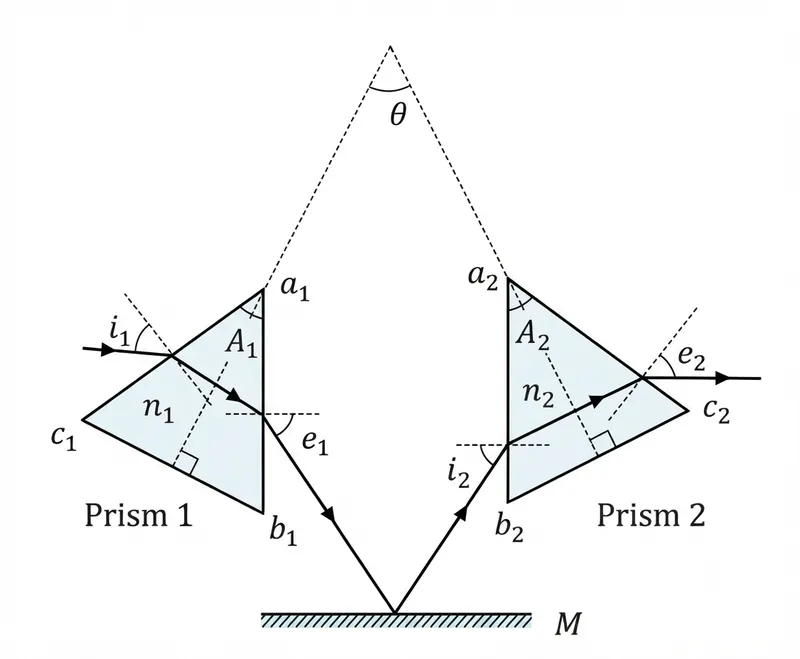
Consider two isosceles prisms 1 and 2 with prism angles A1 and A2 and refractive indices n1 and n2, respectively, as shown in the figure. The faces a1b1 and a2b2 are parallel to each other and perpendicular to the mirror M. If a ray of light is incident on the face a1c1 and emerges from the face a2c2, then the correct statement(s) is/are:
Correct Answer :
If both the prisms are at minimum deviation condition, then .
If both the prisms 1 and 2 are thin and are at minimum deviation condition with angles of deviation δm1 and δm2, respectively, then .
If prism 1 is at minimum deviation condition, then is always true.
Solution :
Correct Options:
1. If both the prisms are at minimum deviation condition, then .
2. If both the prisms 1 and 2 are thin and are at minimum deviation condition with angles of deviation δm1 and δm2, respectively, then .
3. If prism 1 is at minimum deviation condition, then is always true.
Analysis of the Given Setup:
From the given figure:
We have two isosceles prisms with apex angles A1 and A2 and refractive indices n1 and n2. The base faces a1b1 and a2b2 are perpendicular to the plane mirror M. The extensions of the base faces a1b1 and a2b2 intersect at an angle θ at the top.
Since a1b1 and a2b2 are both perpendicular to mirror M, the normals to the surfaces a1b1 and a2b2 are parallel to the mirror M (horizontal).
The ray emerges from face a1b1 at an angle of emergence e1 relative to the normal of a1b1. The angle made by the ray leaving prism 1 with the mirror M is equal to the angle with the base a1b1, which is:
Upon reflection at the plane mirror M, the angle of incidence equals the angle of reflection. Thus, the ray strikes the face a2b2 of Prism 2 at an angle of incidence i2 with its normal such that:
Step-by-step Verification of Statements:
1. Condition when Prism 1 is at Minimum Deviation:
When Prism 1 is at minimum deviation condition:
• The ray inside Prism 1 passes symmetrically, so the angle of refraction at the first face is .
• The angle of incidence equals the angle of emergence, i.e., .
• Applying Snell's law at the emerging face a1b1 of Prism 1:
Since , we directly obtain:
Therefore, the statement "If prism 1 is at minimum deviation condition, then is always true" is correct.
2. Condition when both prisms are at Minimum Deviation:
If Prism 2 is also at minimum deviation condition, then its angle of incidence i2 must satisfy:
Equating both expressions for :
Rearranging the terms yields:
Therefore, the statement "If both the prisms are at minimum deviation condition, then " is correct.
3. Condition for Thin Prisms at Minimum Deviation:
For a thin prism of angle A and refractive index n at minimum deviation:
Thus:
and
From the geometry of the triangle formed by extending faces a1b1 and a2b2:
The base angle of prism 1 is and for prism 2 is .
The interior angles of the triangle with apex angle θ are and .
Summing the angles in the top triangle gives:
+
Substituting and :
Thus, this statement is also correct.
Access expert-curated educational resources and study materials—completely free.
Create, conduct, and manage professional online assessments with Mindyard. Perfect for teachers and institutes.
Copyright © 2026 Mindyard. All Rights Reserved.