
Considering the following reaction sequence,
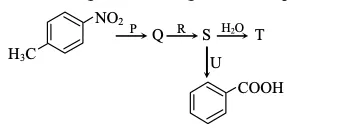
the correct option(s) is (are)
Options
P = H2/Pd, ethanol; R = NaNO2/HCl; U = 1. H3PO2, 2. KMnO4 − KOH, heat.



Solution :
The correct options are:
1. P = H2/Pd, ethanol; R = NaNO2/HCl; U = 1. H3PO2, 2. KMnO4 − KOH, heat.
2.
3.
Let us analyze the reaction sequence given in the question:
Step-by-Step Analysis of the Reaction Steps:
1. Reduction of 4-nitrotoluene (Starting reactant) to 4-methylaniline (Q):
The starting reactant is 4-nitrotoluene (p-nitrotoluene).
Treatment with reagent P reduces the nitro group (-NO2) into an amino group (-NH2) while leaving the methyl group (-CH3) unaffected.
Suitable reagents for P:
- catalytic reduction: H2/Pd in ethanol, or
- metal reduction: Sn/HCl or Fe/HCl.
Thus, intermediate Q is 4-methylaniline (p-toluidine).
2. Diazotization of Q to form Diazonium Salt (S):
Treatment of 4-methylaniline (Q) with reagent R converts the primary aromatic amine group into a diazonium salt.
Reagent R is NaNO2/HCl (or HNO2) at 0–5 °C.
This yields the diazonium salt S: 4-methylbenzenediazonium chloride, which has the structure:
(where P = Sn/HCl, R = HNO2, and S = 4-methylbenzenediazonium chloride).
3. Conversion of Diazonium Salt S to T:
Warming the diazonium salt S with water (H2O) replaces the diazonium group (-N2+Cl-) with a hydroxyl group (-OH).
Thus, product T is 4-methylphenol (p-cresol), represented by:
4. Conversion of Diazonium Salt S to Benzoic Acid:
To convert S (4-methylbenzenediazonium chloride) into benzoic acid:
- First, the diazonium group (-N2+Cl-) must be deaminated (replaced by -H) to yield toluene. Reagents suitable for deamination are hypophosphorous acid (H3PO2) or ethanol (CH3CH2OH).
- Second, the methyl group (-CH3) on the benzene ring is oxidized to a carboxylic acid group (-COOH) using a strong oxidizing agent like alkaline KMnO4 (KMnO4 − KOH, heat) followed by acidic workup.
Therefore, step U consists of:
1. H3PO2 (or CH3CH2OH), followed by 2. KMnO4 − KOH, heat.
Evaluating the given options:
- Option 1 is correct as P = H2/Pd, ethanol; R = NaNO2/HCl; U = 1. H3PO2, 2. KMnO4 − KOH, heat.
- Option 2 () correctly identifies P = Sn/HCl, R = HNO2, and S.
- Option 3 () correctly identifies S, T = 4-methylphenol, and U = 1. CH3CH2OH, 2. KMnO4 − KOH, heat.
Completely free for students. Educators & coaching institutes get 2 months free Pro trial to create tests.
Access unlimited practice questions, detailed step-by-step solutions, and exam study materials — completely free for students.
Create and conduct professional online assessments with AI question generation, tab proctoring, and comprehensive batch management.

A comprehensive JEE Advanced 2022 Paper 1 designed to help aspirants understand the examination pattern, difficulty level, and question trends of JEE Advanced. This paper covers important concepts from Physics, Chemistry, and Mathematics, featuring a balanced mix of conceptual, numerical, and advanced application-based questions. It helps students strengthen conceptual understanding, enhance analytical and problem-solving skills, and improve speed and accuracy. Ideal for practice, revision, self-assessment, previous year trend analysis, concept reinforcement, and time management, this paper is a valuable resource for effective JEE Advanced preparation.

A comprehensive JEE Advanced 2022 Paper 2 designed to help aspirants understand the examination pattern, difficulty level, and question trends of JEE Advanced. This paper covers important concepts from Physics, Chemistry, and Mathematics, featuring a balanced mix of conceptual, numerical, and advanced application-based questions. It helps students strengthen conceptual understanding, enhance analytical and problem-solving skills, and improve speed and accuracy. Ideal for practice, revision, self-assessment, previous year trend analysis, concept reinforcement, and time management, this paper is a valuable resource for effective JEE Advanced preparation.
Copyright © 2026 Combe Labs Private Limited. All Rights Reserved.


