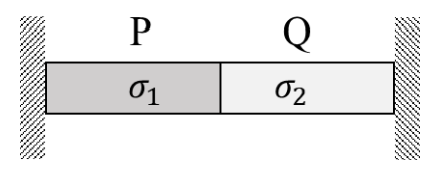
Cylindrical bars P and Q have identical lengths and radii, but are composed of different linear elastic materials. The Young's modulus and coefficient of thermal expansion of Q are twice the corresponding values of P. Assume the bars to be perfectly bonded at the interface, and their weights to be negligible.
The bars are held between rigid supports as shown in the figure and the temperature is raised by AT. Assume that the stress in each bar is homogeneous and uniaxial. Denote the magnitudes of stress in P and Q by σ1,and σ2, respectively.
Which of the statement(s) given is/are CORRECT?
Correct Answer :
The interface between P and Q moves to the left after heating
σ1 = σ2
Solution :
Correct Answer:
The correct statements are:
Step-by-Step Explanation:
1. Analysis of Stress in the Bars (σ1 and σ2):
The schematic shows two cylindrical bars, P (on the left) and Q (on the right), perfectly bonded at their interface and constrained between rigid, unyielding supports on both ends. When the temperature of the system is raised by ΔT, the bars attempt to expand thermally. Since they are confined, the rigid walls exert compressive reaction forces on the ends of the bars.
For static equilibrium of the combined assembly, the compressive force in bar P (denoted by RP) and the compressive force in bar Q (denoted by RQ) must be equal. Therefore, we have:
Here, R is the axial internal force acting throughout the length of both bars.
The problem states that the cylindrical bars have identical lengths (LP = LQ = L) and identical radii. Since their radii are identical, their cross-sectional areas are also equal:
Stress is defined as the internal normal force per unit cross-sectional area. The magnitude of stress in bar P (σ1) and bar Q (σ2) is:
and
Therefore, we directly find:
2. Movement of the Interface:
To determine how the interface moves, we calculate the individual changes in length of each bar. Let the material parameters of bar P be:
Young's modulus:
Coefficient of thermal expansion:
According to the problem, the parameters for bar Q are twice the corresponding values of P:
Young's modulus:
Coefficient of thermal expansion:
The total deformation of each bar consists of a thermal expansion component and a mechanical compression component.
For bar P:
For bar Q:
Since the ends of the combined bar are held between rigid supports, the total length cannot change, meaning the sum of the deformations must be zero:
Substituting the expressions:
Solving for R:
Now, we substitute this value of the axial reaction force R back into the deformation equations for P and Q:
Since is negative (), bar P experiences net contraction. Since is positive (), bar Q experiences net expansion. Because the left end of bar P and the right end of bar Q are held fixed by the rigid walls, the expansion of Q pushes the bonded interface to the left, compressing P. Thus, the interface between P and Q moves to the left after heating.
Access expert-curated educational resources and study materials—completely free.
Create, conduct, and manage professional online assessments with Mindyard. Perfect for teachers and institutes.
Copyright © 2026 Mindyard. All Rights Reserved.