
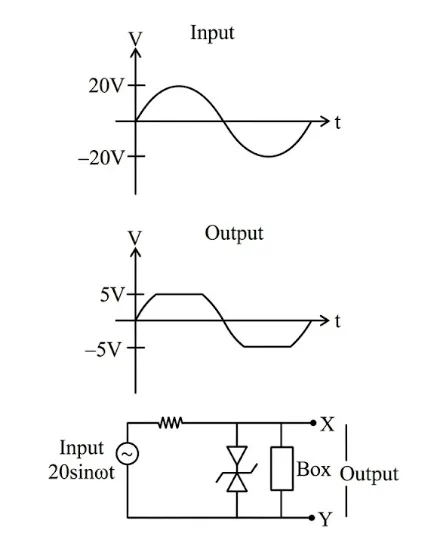
Diagram shows a circuit consisting of some elements. The input and output of the circuit is shown. Choose the correct option that shows the component in box. (Zener diode has a breakdown potential of 5V)
Options




Solution :
The correct option is Option 4 (as shown in the fourth image, consisting of a Zener diode pointing from X to Y in series with a standard diode pointing from Y to X).
Step-by-Step Analysis:
1. Input and Output Waveforms:
The input voltage is given as:
This is an alternating voltage source with a peak value of 20 V. The output waveform is symmetric and clipped at exactly +5 V and -5 V. The Zener breakdown potential is given as .
2. Operation in the Positive Half-Cycle ():
During the positive half-cycle, terminal X is at a higher potential than terminal Y ().
Looking at the middle branch containing two back-to-back Zener diodes:
- The upper Zener diode (pointing down) is forward-biased.
- The lower Zener diode (pointing up) is reverse-biased.
Once the potential difference exceeds 5 V, the lower Zener diode undergoes breakdown, clamping the voltage across terminals X and Y at +5 V (assuming ideal diode characteristics where the forward voltage drop is negligible).
For the box component in Option 4: the Zener diode (pointing from X to Y) is forward-biased, and the standard diode (pointing from Y to X) is reverse-biased. Thus, the box acts as an open circuit and does not affect the output voltage, which remains regulated at +5 V by the middle branch.
3. Operation in the Negative Half-Cycle ():
During the negative half-cycle, terminal Y is at a higher potential than terminal X ().
For the component in the box (Option 4):
- The standard diode (pointing from Y to X) is forward-biased and conducts.
- The Zener diode (pointing from X to Y) is reverse-biased.
Once the potential difference reaches the breakdown voltage of 5 V, the Zener diode in the box undergoes breakdown, clamping the output voltage at -5 V.
This ensures that the negative peak is also clipped at exactly -5 V.
Completely free for students. Educators & coaching institutes get 2 months free Pro trial to create tests.
Access unlimited practice questions, detailed step-by-step solutions, and exam study materials — completely free for students.
Create and conduct professional online assessments with AI question generation, tab proctoring, and comprehensive batch management.

A comprehensive JEE Advanced 2022 Paper 1 designed to help aspirants understand the examination pattern, difficulty level, and question trends of JEE Advanced. This paper covers important concepts from Physics, Chemistry, and Mathematics, featuring a balanced mix of conceptual, numerical, and advanced application-based questions. It helps students strengthen conceptual understanding, enhance analytical and problem-solving skills, and improve speed and accuracy. Ideal for practice, revision, self-assessment, previous year trend analysis, concept reinforcement, and time management, this paper is a valuable resource for effective JEE Advanced preparation.

A comprehensive JEE Advanced 2022 Paper 2 designed to help aspirants understand the examination pattern, difficulty level, and question trends of JEE Advanced. This paper covers important concepts from Physics, Chemistry, and Mathematics, featuring a balanced mix of conceptual, numerical, and advanced application-based questions. It helps students strengthen conceptual understanding, enhance analytical and problem-solving skills, and improve speed and accuracy. Ideal for practice, revision, self-assessment, previous year trend analysis, concept reinforcement, and time management, this paper is a valuable resource for effective JEE Advanced preparation.
Copyright © 2026 Combe Labs Private Limited. All Rights Reserved.


