Direction for the question 41 to 45: Question is based on following passage:
Methyl nitrile is hydrolysed to carboxylic acid in the
presence of H+ or OH- as catalyst. An intermediate
compound [A] is formed during this reaction.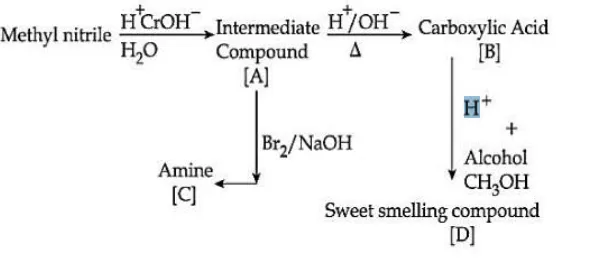
The intermediate compound [Al is:
Correct Answer :
Ethan amide
Solution :
The correct option is Ethan amide.
Step-by-step Explanation:
1. Identification of the Starting Material:
The reaction scheme in the image starts with Methyl nitrile (also known as acetonitrile or ethanenitrile), which has the chemical formula:
2. Partial Hydrolysis (Formation of Intermediate [A]):
As shown in the reaction flowchart, treating methyl nitrile with water in the presence of an acid () or base () catalyst results in partial hydrolysis. This converts the nitrile group () into an amide group (). The intermediate compound [A] formed is ethanamide (commonly called acetamide):
3. Verification via Complete Hydrolysis to Carboxylic Acid [B]:
According to the scheme, heating () Intermediate [A] in acidic or basic conditions completes the hydrolysis to form Carboxylic Acid [B], which is ethanoic acid (acetic acid):
4. Verification via Hoffmann Bromamide Reaction (Formation of Amine [C]):
Intermediate [A] reacts with bromine and sodium hydroxide (). This is the Hoffmann bromamide degradation, which degrades an amide to a primary amine with one less carbon atom. Ethanamide degrades to methylamine, which corresponds to Amine [C]:
5. Esterification (Formation of Sweet-Smelling Compound [D]):
Carboxylic Acid [B] (ethanoic acid) reacts with methanol () under acidic catalyst conditions () to undergo esterification, producing the sweet-smelling ester methyl ethanoate (methyl acetate) as Compound [D]:
All reactions in the scheme confirm that the intermediate compound [A] is ethanamide.
Access expert-curated educational resources and study materials—completely free.
Create, conduct, and manage professional online assessments with Mindyard. Perfect for teachers and institutes.
Copyright © 2026 Mindyard. All Rights Reserved.