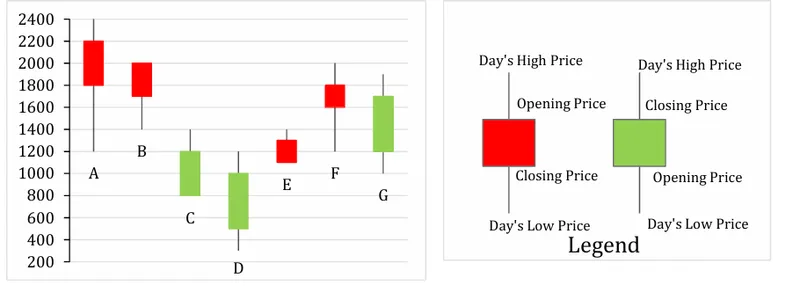
Directions (Q.25-Q.28): The chart below shows the price data for seven shares – A, B, C, D, E, F, and G as a candlestick plot for a particular day. The vertical axis shows the price of the share in rupees. A share whose closing price (price at the end of the day) is more than its opening price (price at the start of the day) is called a bullish share; otherwise, it is called a bearish share. All bullish and bearish shares are shown in green and red colour respectively.
What would have been the percentage wealth gain for a trader, who bought equal numbers of all bullish shares at opening price and sold them at
their day’s high?
Solution :
The correct option is 80%.
To find the percentage wealth gain for the trader, we analyze the price data of the bullish shares from the given candlestick chart. According to the legend:
1. A bullish share is shown in green.
2. For a bullish share, the bottom of the solid green box represents the opening price, and the top of the vertical line (wick) represents the day's high price.
From the chart, the green (bullish) shares are C, D, and G. Let us determine their opening prices and day's high prices:
Share C:
- Opening Price (bottom of the green box) = 800 rupees
- Day's High Price (top of the upper wick) = 1400 rupees
Share D:
- Opening Price (bottom of the green box) = 500 rupees (midway between 400 and 600)
- Day's High Price (top of the upper wick) = 1200 rupees
Share G:
- Opening Price (bottom of the green box) = 1200 rupees
- Day's High Price (top of the upper wick) = 1900 rupees (midway between 1800 and 2000)
Now, let us calculate the total cost price for buying equal numbers (1 share each) of all bullish shares at their opening prices:
Next, we calculate the total selling price by selling these shares at their day's high prices:
The wealth gain (profit) made by the trader is:
Substituting the values:
The percentage wealth gain is calculated as:
Substituting the calculated values into this formula:
Thus, the trader's percentage wealth gain is 80%.
Completely free for students. Educators & coaching institutes get 2 months free Pro trial to create tests.
Access unlimited practice questions, detailed step-by-step solutions, and exam study materials — completely free for students.
Create and conduct professional online assessments with AI question generation, tab proctoring, and comprehensive batch management.

Prepare effectively for CAT 2017 Slot 1 with this complete question paper and detailed solutions. This paper includes all sections—Verbal Ability & Reading Comprehension (VARC), Data Interpretation & Logical Reasoning (DILR), and Quantitative Aptitude (QA)—with step-by-step explanations to help you understand concepts, improve problem-solving speed, and strengthen your exam strategy. Practicing the CAT 2017 Slot 1 paper is an excellent way to experience the actual exam pattern, difficulty level, and question types asked in the Common Admission Test. This resource is ideal for MBA aspirants targeting top IIMs and other leading B-schools.

Prepare for CAT 2017 Slot 2 with the complete question paper and detailed solutions. This paper covers all three sections—Verbal Ability & Reading Comprehension (VARC), Data Interpretation & Logical Reasoning (DILR), and Quantitative Aptitude (QA)—with clear, step-by-step explanations to help you master important concepts and improve your problem-solving speed. Solving the CAT 2017 Slot 2 paper gives you valuable insight into the actual exam pattern, question types, and difficulty level of the Common Admission Test. It is an essential practice resource for MBA aspirants aiming for admission to IIMs and other top B-schools.
Copyright © 2026 Combe Labs Private Limited. All Rights Reserved.