
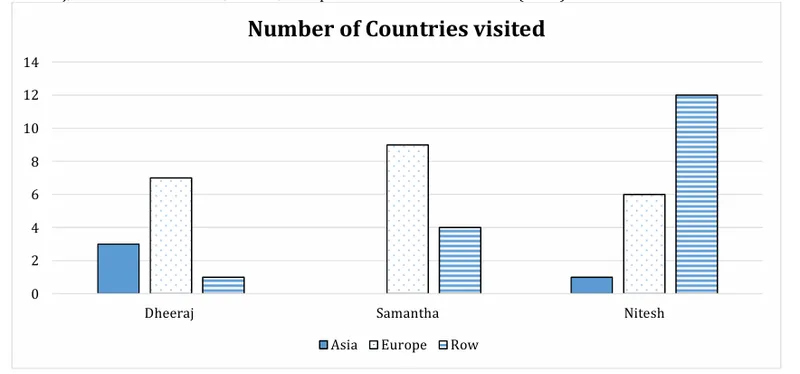
Directions (Q.38-Q.41): The chart below provides complete information about the number of countries visited by Dheeraj, Samantha and Nitesh, in Asia, Europe and the rest of the world (ROW).
The following additional facts are known about the countries visited by them.
1. 32 countries were visited by at least one of them.
2. USA (in ROW) is the only country that was visited by all three of them.
3. China (in Asia) is the only country that was visited by both Dheeraj and Nitesh, but not by Samantha.
4. France (in Europe) is the only country outside Asia, which was visited by both Dheeraj and Samantha, but not by Nitesh.
5. Half of the countries visited by both Samantha and Nitesh are in Europe.
How many countries in Europe were visited by exactly one of Dheeraj, Samantha and Nitesh?
Solution :
The correct answer is 12.
Step 1: Extract and Interpret Data from the Bar Chart
Based on the provided bar chart titled "Number of Countries visited", we can determine the number of countries visited by Dheeraj, Samantha, and Nitesh in each of the three regions: Asia, Europe, and the Rest of the World (ROW).
Let us represent the regions as:
• Asia (A): represented by the solid blue bars.
• Europe (E): represented by the dotted bars.
• Rest of the World (ROW): represented by the horizontally striped bars.
From the chart:
• Dheeraj: Visited 3 in Asia, 7 in Europe, and 1 in ROW.
• Samantha: Visited 0 in Asia, 9 in Europe, and 4 in ROW.
• Nitesh: Visited 1 in Asia, 6 in Europe, and 12 in ROW.
Step 2: Define Venn Diagram Components for each Region
Let us analyze each region using set theory. For any region X (where X ∈ {Asia, Europe, ROW}):
• , , and are the total countries visited by Dheeraj, Samantha, and Nitesh in region X, respectively.
• Let , , and denote the sets of countries visited by each person in region X.
• Let , , and be the countries in region X visited by exactly one of them.
• Let , , and be the countries visited by exactly two of them.
• Let be the countries visited by all three of them in region X.
Step 3: Apply the Additional Facts
Fact 1: Total unique countries visited across all three regions is 32.
Fact 2: USA (in ROW) is the only country visited by all three. This means:
Fact 3: China (in Asia) is the only country visited by both Dheeraj and Nitesh, but not by Samantha. This means:
Fact 4: France (in Europe) is the only country outside Asia visited by both Dheeraj and Samantha, but not Nitesh. This means:
Furthermore, since Samantha visited 0 countries in Asia, we automatically have:
and
Step 4: Solve for each Region
1. Asia:
Since Samantha visited 0 countries in Asia, only Dheeraj and Nitesh visited countries in Asia.
For Dheeraj: .
For Nitesh: .
Since (China), Nitesh's single country in Asia must be China.
Thus, and .
Total unique countries in Asia = .
2. Rest of the World (ROW):
We have:
•
•
•
• (USA)
•
•
For Dheeraj:
Let .
For Samantha:
For Nitesh:
Total unique countries in ROW:
3. Europe:
We have:
•
•
•
•
•
• (France)
Fact 5: Half of the countries visited by both Samantha and Nitesh are in Europe.
The total number of countries visited by both Samantha and Nitesh is:
Therefore:
Now let us express the exclusive (visited by exactly one person) values for Europe:
For Dheeraj:
For Samantha:
For Nitesh:
Total unique countries in Europe:
Step 5: Find the Value of y
Since the total unique countries visited across all regions is 32:
Step 6: Calculate European Countries Visited by Exactly One Person
Now we substitute into the expressions for the number of countries in Europe visited by exactly one of Dheeraj, Samantha, and Nitesh:
• Visited only by Dheeraj:
• Visited only by Samantha:
• Visited only by Nitesh:
Summing these up:
Thus, exactly 12 countries in Europe were visited by only one of Dheeraj, Samantha, or Nitesh.
Completely free for students. Educators & coaching institutes get 2 months free Pro trial to create tests.
Access unlimited practice questions, detailed step-by-step solutions, and exam study materials — completely free for students.
Create and conduct professional online assessments with AI question generation, tab proctoring, and comprehensive batch management.

Practice the complete CLAT 2015 UG Question Paper to improve your preparation for the Common Law Admission Test. This previous year paper covers the key sections of CLAT UG, including English, General Knowledge & Current Affairs, Elementary Mathematics, Legal Aptitude, and Logical Reasoning. Solve CLAT 2015 UG questions to understand the previous year exam pattern, practice important concepts, improve accuracy and speed, and prepare effectively for law entrance examinations.

Prepare for CLAT 2019 UG with the complete question paper and solutions. This paper covers all major sections of the Common Law Admission Test (CLAT) Undergraduate exam, including English Language, Current Affairs & General Knowledge, Legal Reasoning, Logical Reasoning, and Quantitative Techniques.Use the CLAT 2019 UG question paper to practice exam-level questions, understand the question pattern, improve time management, and strengthen your preparation for law entrance examinations.
Copyright © 2026 Combe Labs Private Limited. All Rights Reserved.


