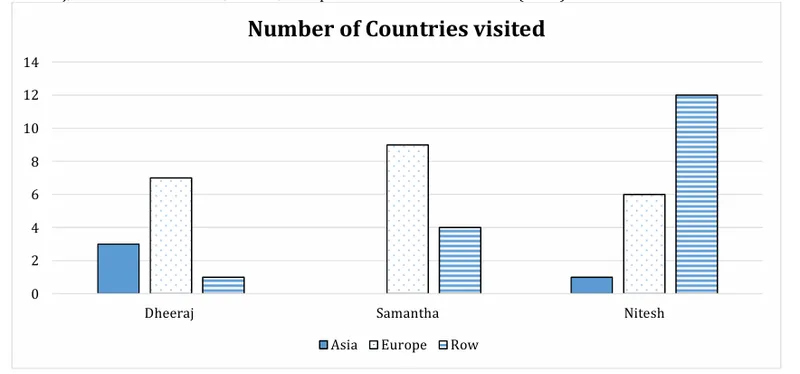
Directions (Q.38-Q.41): The chart below provides complete information about the number of countries visited by Dheeraj, Samantha and Nitesh, in Asia, Europe and the rest of the world (ROW).
The following additional facts are known about the countries visited by them.
1. 32 countries were visited by at least one of them.
2. USA (in ROW) is the only country that was visited by all three of them.
3. China (in Asia) is the only country that was visited by both Dheeraj and Nitesh, but not by Samantha.
4. France (in Europe) is the only country outside Asia, which was visited by both Dheeraj and Samantha, but not by Nitesh.
5. Half of the countries visited by both Samantha and Nitesh are in Europe.
How many countries in the ROW were visited by both Nitesh and Samantha?
Solution :
The correct option is 4.
From the bar chart titled "Number of Countries visited", we can extract the number of countries visited by Dheeraj, Samantha, and Nitesh in each of the three regions: Asia, Europe, and Rest of the World (ROW).
• Dheeraj: Asia = 3, Europe = 7, ROW = 1 (Total = 11)
• Samantha: Asia = 0, Europe = 9, ROW = 4 (Total = 13)
• Nitesh: Asia = 1, Europe = 6, ROW = 12 (Total = 19)
Let us define the variables for the Venn diagram representing the countries visited by Dheeraj (D), Samantha (S), and Nitesh (N) in each region R (where R can be Asia, Europe, or ROW):
• Let dR, sR, and nR represent the number of countries visited exclusively by D, S, and N, respectively, in region R.
• Let dsR represent the number of countries visited by D and S but not N in region R.
• Let dnR represent the number of countries visited by D and N but not S in region R.
• Let snR represent the number of countries visited by S and N but not D in region R.
• Let dsnR represent the number of countries visited by all three in region R.
The sum of the total visits across all travelers is:
According to Fact 1, the total number of unique countries visited by at least one person is:
Using Venn diagram relationships, we know:
where is the number of countries visited by exactly one person, is the number of countries visited by exactly two people, and is the number of countries visited by all three.
Subtracting the two equations gives:
Substituting the values:
Fact 2 states that the USA (in ROW) is the only country visited by all three of them. This means:
Thus, we have and .
Substituting into our equation:
The total number of countries visited by exactly two people, , is the sum:
Let's find the values of and using the remaining facts:
• According to Fact 3, China (in Asia) is the only country visited by D and N but not S. Thus, (with ).
• According to Fact 4, France (in Europe) is the only country outside Asia visited by D and S but not N. Since Samantha visited 0 countries in Asia, there are no countries in Asia visited by D and S. Thus, (with ).
Substituting these values:
Since Samantha visited 0 countries in Asia, . This means:
According to Fact 5, half of the countries visited by both Samantha and Nitesh are in Europe.
The total number of countries visited by both Samantha and Nitesh is:
Thus, the number of countries visited by both in Europe is:
Since , all 4 of these countries must belong to :
Substituting this back into the equation:
The question asks for the total number of countries in the ROW visited by both Nitesh and Samantha. This includes the countries visited by both S and N but not D in ROW (), as well as the country visited by all three of them in ROW (, which is the USA):
Thus, the number of countries in the ROW visited by both Nitesh and Samantha is 4.
Completely free for students. Educators & coaching institutes get 2 months free Pro trial to create tests.
Access unlimited practice questions, detailed step-by-step solutions, and exam study materials — completely free for students.
Create and conduct professional online assessments with AI question generation, tab proctoring, and comprehensive batch management.

A comprehensive SSC MTS 2026 Mock Test 4 designed to help aspirants strengthen their preparation and improve their performance for the Staff Selection Commission Multi-Tasking Staff examination. This mock test covers all major sections including Numerical and Mathematical Ability, Reasoning Ability and Problem Solving, General Awareness, and English Language and Comprehension. It includes a balanced combination of conceptual, analytical, and exam-oriented multiple-choice questions aligned with the latest SSC MTS syllabus and exam pattern. Ideal for practice, revision, self-evaluation, accuracy improvement, speed enhancement, and effective time management, this mock test helps candidates assess their exam readiness, identify improvement areas, and build confidence for the SSC MTS 2026 examination
A comprehensive SSC MTS 2026 Mock Test 3 designed to help aspirants prepare thoroughly for the Staff Selection Commission Multi-Tasking Staff examination. This mock test covers all important sections including Numerical and Mathematical Ability, Reasoning Ability and Problem Solving, General Awareness, and English Language and Comprehension. It features a carefully curated set of multiple-choice questions that test conceptual understanding, logical reasoning, problem-solving skills, speed, and accuracy in accordance with the latest SSC MTS exam pattern. Ideal for practice, revision, self-assessment, performance evaluation, and time management improvement, this mock test enables candidates to identify strengths and weaknesses while building confidence for the SSC MTS 2026 examination.
Copyright © 2026 Combe Labs Private Limited. All Rights Reserved.