During open-heart surgery, a patient’s blood is cooled down to 25 °C from 37 °C using a concentric tube counter-flow heat exchanger. Water enters the heat exchanger at 4 °C and leaves at 18 °C. Blood flow rate during the surgery is 5 L/minute.
Use the following fluid properties:
Fluid Density (kg/m3) Specific heat (J/kg-K) Blood 1050 3740 Water 1000 4200
| Fluid |
Density (kg/m3) |
Specific heat (J/kg-K) |
| Blood |
1050 |
3740 |
| Water |
1000 |
4200 |
Effectiveness of the heat exchanger is _________ (round off to 2 decimal places).
Correct Answer :
Correct answer is : 0.42
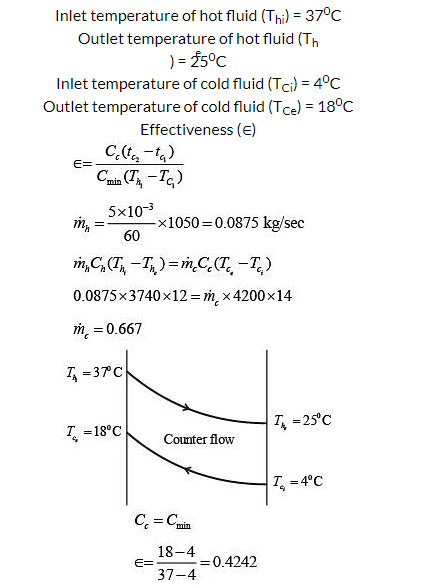
Solution :
The correct answer is 0.42.
1. Identification of Given Parameters:
From the problem statement and the schematic diagram provided in the image, we identify the parameters for the hot fluid (blood) and the cold fluid (water):
- Hot fluid (blood) inlet temperature:
- Hot fluid (blood) outlet temperature:
- Cold fluid (water) inlet temperature:
- Cold fluid (water) outlet temperature:
- Volumetric flow rate of blood:
- Density of blood:
- Specific heat of blood:
- Specific heat of water:
2. Mass Flow Rate and Heat Capacity Rate of Blood (Hot Fluid):
The mass flow rate of blood () is calculated using its density and volumetric flow rate as shown in the image equations:
Now, the heat capacity rate of the hot fluid () is:
3. Heat Capacity Rate of Water (Cold Fluid) via Energy Balance:
The schematic diagram in the image visually represents the counter-flow configuration, showing the hot fluid temperature profile decreasing from 37 °C to 25 °C, and the cold fluid temperature profile flowing in the opposite direction and increasing from 4 °C to 18 °C. Applying the conservation of energy, the heat lost by the blood must equal the heat gained by the water:
Substituting the temperatures and :
4. Determining the Minimum Heat Capacity Rate ():
Comparing the heat capacity rates of both fluids:
- Hot fluid:
- Cold fluid:
Since , the cold fluid capacity rate is the minimum capacity rate:
5. Calculation of Effectiveness ():
The effectiveness of a heat exchanger is defined as:
Because , the capacity rate terms cancel out, simplifying the equation to:
Substituting the temperature values into the simplified expression:
Rounding to two decimal places yields:
Access expert-curated educational resources and study materials—completely free.
Create, conduct, and manage professional online assessments with Mindyard. Perfect for teachers and institutes.
Copyright © 2026 Mindyard. All Rights Reserved.