
Explain the three steps carried out in the formation of recombinant DNA using the enzyme EcoRI.
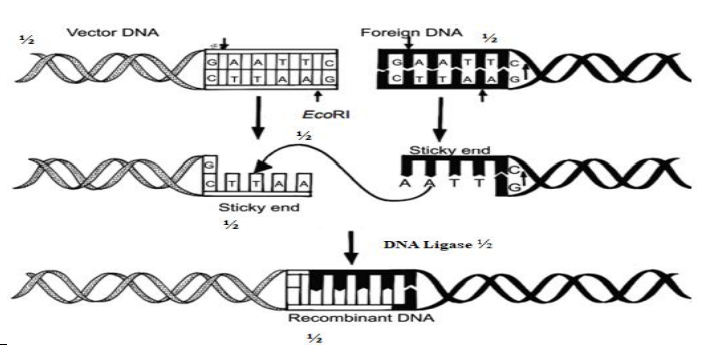
Eco R1 cuts vector DNA , foreign DNA/ gene of interest , at pallindromic site /
3'CTTAAG 5'
5'GAATTC3' (between bases G & A only), sticky end (over hanging stretch of bases) formed at each strand, Joining of sticky ends from DNA fragments by enzyme DNA Ligase, Recombinant DNA(rDNA) is formed
Solution :
Correct Answer:
EcoRI cuts vector DNA and foreign DNA (gene of interest) at the palindromic site:
5'-GAATTC-3'
3'-CTTAAG-5'
(specifically between bases G and A only), forming sticky ends (overhanging stretches of bases) on each strand. The sticky ends from the DNA fragments are then joined by the enzyme DNA Ligase to form Recombinant DNA (rDNA).
Step-by-Step Explanation:
The provided diagram outlines the step-by-step enzymatic process of creating a recombinant DNA molecule using the restriction endonuclease EcoRI. The three essential steps shown in the process are detailed below:
Step 1: Specific Cleavage by EcoRI
The restriction enzyme EcoRI identifies and binds to a specific palindromic nucleotide sequence on both the Vector DNA (represented in white on the left) and the Foreign DNA (represented in black on the right). This recognition sequence is:
5'-GAATTC-3'
3'-CTTAAG-5'
As indicated by the small vertical arrows in the diagram, EcoRI cuts both DNA strands specifically between the Guanine (G) and Adenine (A) bases, leaving the outer parts of the double helix cut in a staggered fashion.
Step 2: Formation of complementary "Sticky Ends"
Because the cuts are staggered rather than straight across, they leave overhanging, single-stranded stretches of nucleotides on each fragment. These are labeled as Sticky ends in the middle section of the diagram. The overhanging sequence on the vector DNA strand is complementary to the overhanging sequence on the foreign DNA strand, allowing them to easily form hydrogen bonds with one another when brought together.
Step 3: Ligation of DNA fragments by DNA Ligase
In the final step, the complementary sticky ends of the vector DNA and foreign DNA pair up. The enzyme DNA Ligase is then added to facilitate the covalent bonding of the sugar-phosphate backbone of the two DNA fragments. This joining process seals the nicks and produces a single, continuous hybrid molecule labeled at the bottom as the Recombinant DNA.
Completely free for students. Educators & coaching institutes get 2 months free Pro trial to create tests.
Access unlimited practice questions, detailed step-by-step solutions, and exam study materials — completely free for students.
Create and conduct professional online assessments with AI question generation, tab proctoring, and comprehensive batch management.

Prepare effectively with the CBSE Class 12 Biology 2022–23 Set - 1 Question Paper. This paper is ideal for students appearing for the CBSE Class 12 Board Examination and helps in understanding the latest exam pattern, question types, and marking scheme. Practice with authentic board-level questions to improve accuracy, time management, and conceptual clarity. The paper includes detailed solutions to help you analyze your performance and strengthen important Biology concepts before the exam.

Practice with the CBSE Class 12 Biology 2022–23 Set - 2 Question Paper to strengthen your preparation for the CBSE Board Examination. This previous year question paper follows the latest CBSE exam pattern and includes a variety of board-level questions covering Genetics, Evolution, Biotechnology, Human Physiology, Reproduction, Ecology, and other important topics. Detailed solutions help you understand the correct approach, improve conceptual clarity, and enhance time management for the final exam. Solving this paper is an excellent way to evaluate your preparation and boost your confidence before the board examination.
Copyright © 2026 Combe Labs Private Limited. All Rights Reserved.
 Set - 3-1782888548748.webp)

