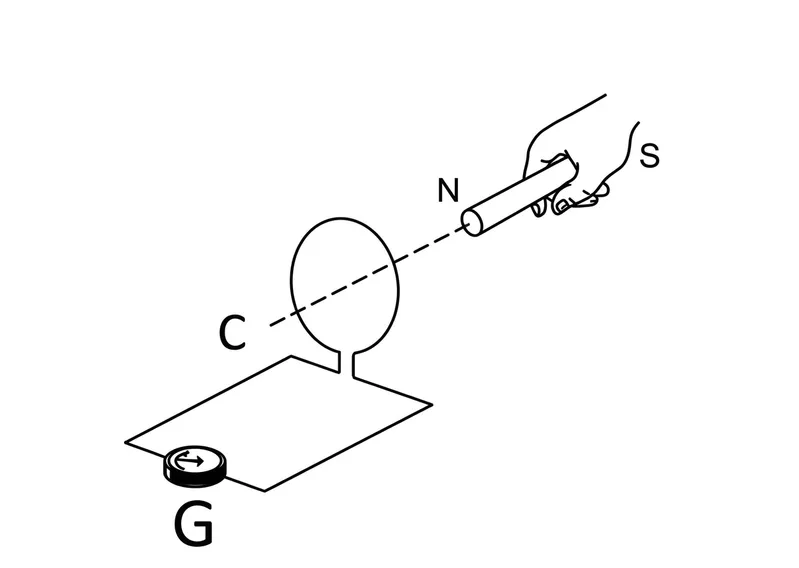
Figure shows a coil C connected to a galvanometer G. When the North-pole of a bar magnet is pushed towards the coil, the pointer in the galvanometer deflects. Regarding this set up, the following statements are given:
(A) It indicates the presence of electric current in the coil.
(B) The deflection is found to be smaller when the magnet is pushed towards the coil faster.
(C) There is repulsion in the moving magnet and the magnetic pole induced in the coil facing towards the N pole of the magnet.
(D) If the bar magnet does not move, there is no induced current in the coil.
Choose the correct answer from the options given below:
Correct Answer :
(A), (C) and (D) only
Solution :
The correct option is (A), (C) and (D) only.
Let's analyze the setup shown in the figure, which consists of a circular coil (labeled C) connected in a closed circuit to a galvanometer (labeled G), and a bar magnet with its North pole (labeled N) and South pole (labeled S) held by a hand and moved along the axis of the coil.
Analysis of the Statements:
Statement (A): "It indicates the presence of electric current in the coil."
A galvanometer is an instrument used to detect the presence and direction of electric current in a circuit. When the magnet moves towards the coil, the deflection of the needle in the galvanometer G shows that an electric current has been induced in coil C. Therefore, Statement (A) is correct.
Statement (B): "The deflection is found to be smaller when the magnet is pushed towards the coil faster."
According to Faraday's law of electromagnetic induction, the induced electromotive force (emf) is proportional to the rate of change of magnetic flux through the coil:
When the magnet is pushed faster, the time duration decreases, making the rate of change of magnetic flux larger. This leads to a larger induced emf, causing a larger current to flow and hence a larger deflection of the galvanometer pointer. Thus, Statement (B) is incorrect.
Statement (C): "There is repulsion in the moving magnet and the magnetic pole induced in the coil facing towards the N pole of the magnet."
According to Lenz's law, the direction of the induced current in the coil is always such that it opposes the change in magnetic flux that produces it. Since the North pole of the magnet is moving towards the coil, the face of the coil facing the magnet develops a North magnetic pole to oppose (repel) this motion. Like poles repel each other, meaning there is indeed a repulsive force between the moving magnet and the coil. Therefore, Statement (C) is correct.
Statement (D): "If the bar magnet does not move, there is no induced current in the coil."
If the magnet is stationary, the magnetic flux through the coil remains constant over time (). Since there is no change in magnetic flux, no emf is induced, and therefore no induced current flows through the coil (the galvanometer pointer remains at zero). Thus, Statement (D) is correct.
In summary, statements (A), (C), and (D) are correct, confirming that (A), (C) and (D) only is the correct answer.
Access expert-curated educational resources and study materials—completely free.
Create, conduct, and manage professional online assessments with Mindyard. Perfect for teachers and institutes.
Copyright © 2026 Mindyard. All Rights Reserved.