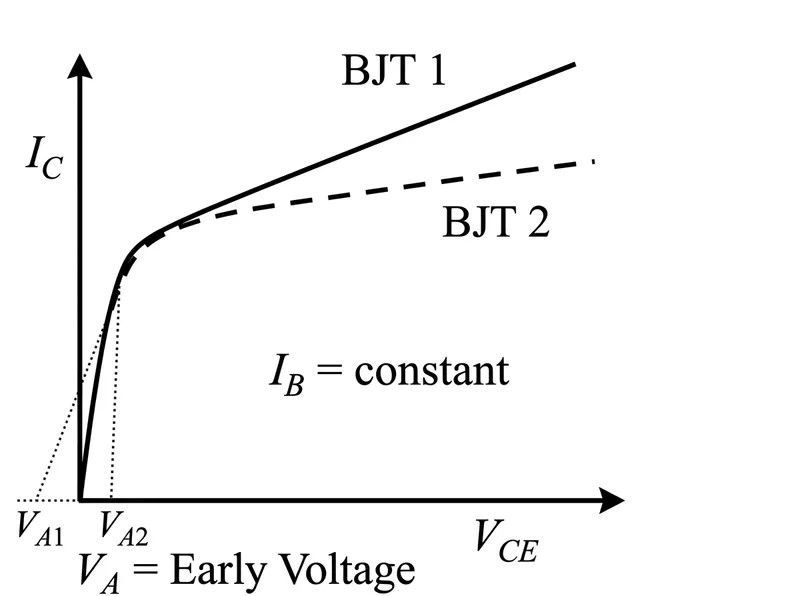
Figure shows the output characteristics of two different Bipolar Junction Transistors (BJT), BJT 1 with magnitude of Early voltage |VA1|, and BJT 2 with magnitude of Early voltage |VA2|. Which of the following options is/are correct regarding the Early voltages?
Correct Answer :
Solution :
The correct options are:
and
Step-by-Step Explanation:
1. Understanding the Early Effect:
The Early effect (base-width modulation) in a Bipolar Junction Transistor (BJT) causes the collector current in the active region to increase slightly with an increase in the collector-to-emitter voltage . The relationship is modeled as:
where is the ideal collector current without the Early effect, and is the magnitude of the Early voltage.
2. Slope of the Characteristics:
Differentiating with respect to in the active region gives the output conductance (slope of the curve):
This demonstrates that the slope of the output characteristic curve is inversely proportional to the magnitude of the Early voltage .
3. Analyzing the Graphical Data:
From the provided image, we can observe the output characteristics for BJT 1 (solid curve) and BJT 2 (dashed curve) at a constant base current :
- The slope of the active region for BJT 1 is steeper than that of BJT 2.
- Mathematically, this is expressed as:
- Substituting the inverse relation with Early voltage:
- Rearranging the inequality yields:
4. Finiteness of Early Voltage:
The extrapolation of the active region slope of BJT 2 intersects the negative voltage axis at a clear, non-infinite point labeled in the diagram. Because the slope is non-zero, this intersection lies at a finite voltage value. Therefore, the magnitude of the Early voltage for BJT 2, , is finite.
Access expert-curated educational resources and study materials—completely free.
Create, conduct, and manage professional online assessments with Mindyard. Perfect for teachers and institutes.
Copyright © 2026 Mindyard. All Rights Reserved.