
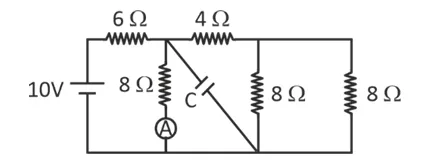
Find current through ammeter (in A)
Solution :
Correct Option: 0.5 A
To find the current flowing through the ammeter, we analyze the circuit in its DC steady-state condition.
Step 1: Analyze the Capacitor Branch
In a DC steady state, a capacitor acts as an open circuit (infinite resistance), meaning no current flows through it. Therefore, we can completely remove the branch containing the capacitor from our calculations.
Step 2: Simplify the Right-Hand Side of the Circuit
After removing the capacitor branch, we observe the following configuration on the right side of the circuit:
The two far-right vertical resistors, each having a resistance of , are connected in parallel. Their equivalent resistance () is calculated as:
This parallel combination is in series with the top-right horizontal resistor of . Thus, the total resistance of this entire right-hand branch () is:
Step 3: Find the Total Equivalent Resistance of the Circuit
Now, looking at the node just after the resistor, the circuit splits into two parallel paths connected to the negative rail:
1. The branch containing the resistor and the ammeter (assuming an ideal ammeter with resistance).
2. The right-hand branch with an equivalent resistance of .
The equivalent resistance of these two parallel branches () is:
This parallel combination is connected in series with the resistor at the positive terminal of the battery. Therefore, the total equivalent resistance of the entire circuit () is:
Step 4: Calculate the Currents
Using Ohm's law, the total current () supplied by the battery is:
Since the current splits at the node after the resistor into two parallel branches of equal resistance ( each), the current divides equally between them. Thus, the current flowing through the branch containing the ammeter () is:
Completely free for students. Educators & coaching institutes get 2 months free Pro trial to create tests.
Access unlimited practice questions, detailed step-by-step solutions, and exam study materials — completely free for students.
Create and conduct professional online assessments with AI question generation, tab proctoring, and comprehensive batch management.

A comprehensive JEE Advanced 2022 Paper 1 designed to help aspirants understand the examination pattern, difficulty level, and question trends of JEE Advanced. This paper covers important concepts from Physics, Chemistry, and Mathematics, featuring a balanced mix of conceptual, numerical, and advanced application-based questions. It helps students strengthen conceptual understanding, enhance analytical and problem-solving skills, and improve speed and accuracy. Ideal for practice, revision, self-assessment, previous year trend analysis, concept reinforcement, and time management, this paper is a valuable resource for effective JEE Advanced preparation.

A comprehensive JEE Advanced 2022 Paper 2 designed to help aspirants understand the examination pattern, difficulty level, and question trends of JEE Advanced. This paper covers important concepts from Physics, Chemistry, and Mathematics, featuring a balanced mix of conceptual, numerical, and advanced application-based questions. It helps students strengthen conceptual understanding, enhance analytical and problem-solving skills, and improve speed and accuracy. Ideal for practice, revision, self-assessment, previous year trend analysis, concept reinforcement, and time management, this paper is a valuable resource for effective JEE Advanced preparation.
Copyright © 2026 Combe Labs Private Limited. All Rights Reserved.


