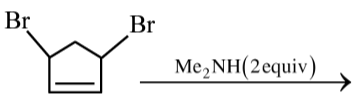
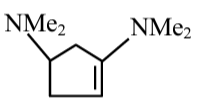
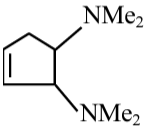
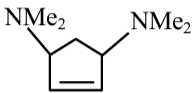
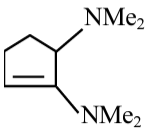
Find out the major product formed from the following reaction. [Me: –CH3]
Correct Answer :
Solution :
The correct option is Option 2 (represented by the image of trans-3,4-bis(dimethylamino)cyclopentene, or trans-N,N,N',N'-tetramethylcyclopent-3-ene-1,2-diamine).
Reaction Analysis and Mechanism:
The starting material is 3,5-dibromocyclopentene. It contains two allylic bromine atoms at the C3 and C5 positions relative to the C1=C2 double bond. When treated with two equivalents of a secondary amine, dimethylamine (), the reaction proceeds through a combination of allylic substitution () and direct substitution () mechanisms:
Step 1: First Substitution (Allylic Rearrangement)
In the first step, the nucleophile dimethylamine () attacks the C1 position of the double bond in an allylic nucleophilic substitution () manner. This attack causes the double bond to shift from C1=C2 to C2=C3, expelling the bromine atom at C3 as a bromide ion (). This yields the mono-substituted intermediate, 5-bromo-3-(dimethylamino)cyclopentene.
Step 2: Second Substitution (Direct Nucleophilic Substitution)
In the second step, the second equivalent of dimethylamine attacks the remaining bromine-bearing carbon atom (C5) via a direct bimolecular nucleophilic substitution () mechanism, expelling the second bromide ion. Because C5 is adjacent to C1 (which now bears the first dimethylamino group), the resulting product has the two dimethylamino groups on adjacent carbons (C1 and C5, or C3 and C4 using IUPAC numbering for the cyclopentene ring).
Stereochemistry:
Due to steric hindrance and thermodynamic stability, the two bulky dimethylamino () groups occupy positions on opposite faces of the cyclopentene ring. Thus, the major product is exclusively the trans-isomer: trans-3,4-bis(dimethylamino)cyclopentene.
Access expert-curated educational resources and study materials—completely free.
Create, conduct, and manage professional online assessments with Mindyard. Perfect for teachers and institutes.
Copyright © 2026 Mindyard. All Rights Reserved.