Find the difference between the average number of beaches in D, E and C and the average number of mountains in B, A and E.
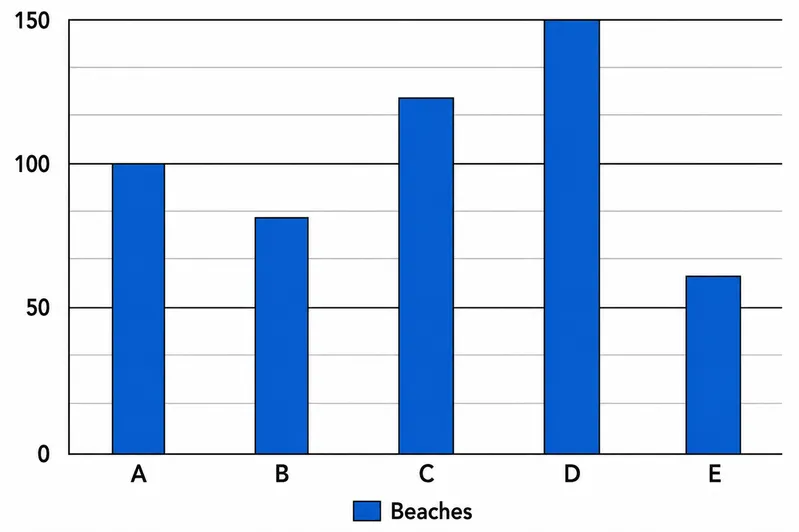
Read the following bar graph and table carefully and answer the questions given below. The bar graph shows total number of beaches in five different countries. The table shows percentage of mountains out of total beaches and mountains together in these countries.
| Countries | Percentage of mountains out of total beaches and mountains together |
|---|---|
| A | 60% |
| B | 75% |
| C | 20% |
| D | 80% |
| E | 50% |
Correct Answer :
40
Solution :
The correct answer is 40.
From the provided bar graph, we can observe the total number of beaches in each country:
• Country A = 100
• Country B = 80
• Country C = 120
• Country D = 150
• Country E = 60
Let represent the number of mountains and represent the number of beaches in a country. The percentage of mountains out of the total beaches and mountains together is given by:
Rearranging this formula, we can calculate the number of mountains () directly using the number of beaches ():
Now, let us find the number of mountains in countries B, A, and E:
1. Country B:
Percentage of mountains = 75%
2. Country A:
Percentage of mountains = 60%
3. Country E:
Percentage of mountains = 50%
Now, calculate the required averages:
Average number of beaches in D, E, and C:
Average number of mountains in B, A, and E:
Finally, calculate the difference between the two averages:
Access expert-curated educational resources and study materials—completely free.
Create, conduct, and manage professional online assessments with Mindyard. Perfect for teachers and institutes.
Copyright © 2026 Mindyard. All Rights Reserved.