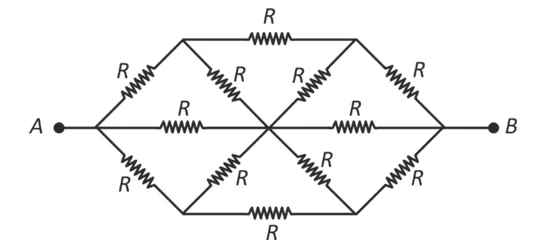
Find the equivalent resistance between A & B of the resistor’s network. Each value of the resistor is R.
Correct Answer :
4R/5
Solution :
The correct option is 4R/5.
Let us find the equivalent resistance between terminals A and B by utilizing the symmetry of the circuit network shown in the image.
Looking at the provided circuit diagram, we observe a symmetric network of 12 resistors, each of value R, connected between terminal A on the left and terminal B on the right.
Let us label the key nodes in the network as follows:
- A: The input terminal node on the far left.
- B: The output terminal node on the far right.
- O: The central intersection node.
- C: The upper-left junction node connected to A, O, and E.
- D: The lower-left junction node connected to A, O, and F.
- E: The upper-right junction node connected to B, O, and C.
- F: The lower-right junction node connected to B, O, and D.
To analyze the circuit, we apply a potential difference of 1 V across the terminals by setting the potentials:
Due to the top-bottom symmetry of the circuit, the potentials at the symmetric upper and lower nodes must be equal:
Due to the left-right symmetry and the applied potentials, the potential at the central node O is exactly halfway between the terminal potentials:
Furthermore, the potential distribution must satisfy the relation:
Now, let us write Kirchhoff's Current Law (KCL) at node C. The sum of currents leaving node C through the three connected resistors must be zero:
Multiplying the entire equation by R and substituting the known potential values:
Simplify this equation to solve for :
Therefore, we have:
Now, let us calculate the total current I entering the network at node A:
Substitute the values of the potentials:
Finally, we apply Ohm's law to the equivalent network to determine the equivalent resistance :
Access expert-curated educational resources and study materials—completely free.
Create, conduct, and manage professional online assessments with Mindyard. Perfect for teachers and institutes.
Copyright © 2026 Mindyard. All Rights Reserved.