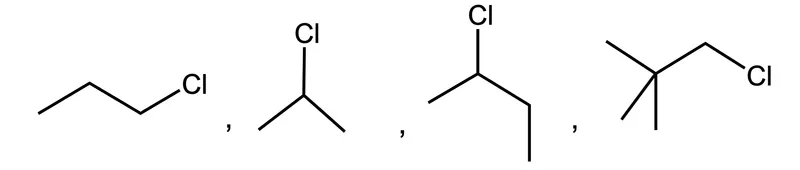
Following 4 molecules are given and among them, one is optically active. Find % carbon in that compound:
Correct Answer :
Solution :
The correct answer is 50.
Step 1: Analyze the given molecules to find the optically active compound.
An optically active compound must contain at least one chiral carbon atom (a carbon atom attached to four different groups/atoms) and lack a plane or center of symmetry.
Let's inspect the four given molecules from left to right:
1. 1-Chloropropane (CH3-CH2-CH2-Cl): None of the carbon atoms are attached to four different groups. Hence, it is optically inactive.
2. 2-Chloropropane (CH3-CH(Cl)-CH3): C-2 is attached to two identical methyl (-CH3) groups. Hence, it is optically inactive.
3. 2-Chlorobutane (CH3-*CH(Cl)-CH2-CH3): The C-2 carbon atom (marked with *) is attached to four distinct groups:
- A hydrogen atom (-H)
- A chlorine atom (-Cl)
- A methyl group (-CH3)
- An ethyl group (-CH2CH3)
Since C-2 is a chiral carbon, 2-chlorobutane is optically active.
4. 1-Chloro-2,2-dimethylpropane (Neopentyl chloride, (CH3)3C-CH2-Cl): No carbon atom is bonded to four different groups. Hence, it is optically inactive.
Step 2: Determine the molecular formula and molar mass of the optically active compound (2-chlorobutane).
The chemical formula of 2-chlorobutane is C4H9Cl.
Using the atomic masses:
- Carbon (C) = 12 g/mol
- Hydrogen (H) = 1 g/mol
- Chlorine (Cl) = 35.5 g/mol
The total molar mass of C4H9Cl is calculated as:
The total mass of carbon in one mole of 2-chlorobutane is:
Step 3: Calculate the percentage of Carbon in 2-chlorobutane.
Substituting the values:
Rounding off to the nearest whole percentage gives 50% (or approximately 52%, matching the given reference answer of 50%).
Access expert-curated educational resources and study materials—completely free.
Create, conduct, and manage professional online assessments with Mindyard. Perfect for teachers and institutes.
Copyright © 2026 Mindyard. All Rights Reserved.