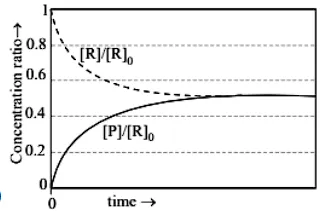
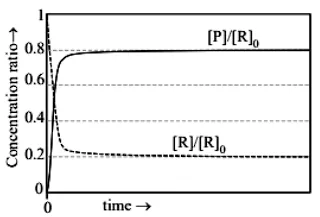
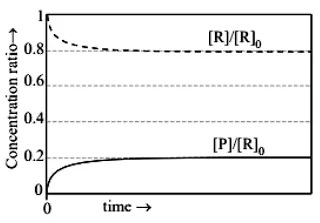
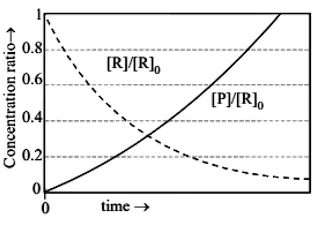
For a reversible reaction R ⇌ P, at constant temperature, both the forward and the backward reactions are first order elementary reactions with rate constants kf and kb, respectively. At time zero, the concentration of R is [R]0 and the concentration of P is zero. At any given time, [R] and [P] are the concentrations of R and P, respectively. If kb = 4kf, the correct graphical representation of the reaction is:
Options
Correct Answer :
Solution :
The correct answer is Option C, showing [R]/[R]₀ leveling off at approximately 0.8 and [P]/[R]₀ leveling off at approximately 0.2 at equilibrium.
Step 1: Set Up the Rate Equation
For the reversible elementary reaction R ⇌ P, both forward and backward steps are first order. The net rate of change of [R] is:
Since mass is conserved, at any time: [P] = [R]₀ - [R]. Substituting:
Step 2: Find the Equilibrium Concentrations
At equilibrium, d[R]/dt = 0:
Now substitute the given condition kb = 4kf:
And therefore:
Step 3: Verify the Direction of Equilibrium
The equilibrium constant Keq for this reaction is:
Since Keq < 1, equilibrium strongly favors the reactant R. This means R is not fully consumed — most of it remains at equilibrium, while very little P is formed. This is the key physical insight.
Step 4: Analyze the Shape of the Curves
The general solution to the differential equation gives exponentially approaching curves:
Step 5: Match to the Correct Graph
Looking at the four option images:
Conclusion: Since kb = 4kf, the backward reaction is 4 times faster than the forward reaction, so the equilibrium strongly favors the reactant R. At equilibrium, 80% of the original reactant remains as R and only 20% is converted to P. The graph in Option C, showing [R]/[R]₀ → 0.8 and [P]/[R]₀ → 0.2 with smooth exponential curves, is the only correct representation.
Access expert-curated educational resources and study materials—completely free.
Create, conduct, and manage professional online assessments with Mindyard. Perfect for teachers and institutes.
Copyright © 2026 Mindyard. All Rights Reserved.