For the function f(x) = 2x3 − 9x2 + 12x − 5, x ∈ [0,3], match List-I with List-II:
Correct Answer :
(A)- (IV), (B)- (III), (C)- (I), (D)- (II)
Solution :
The correct option is: (A)- (IV), (B)- (III), (C)- (I), (D)- (II).
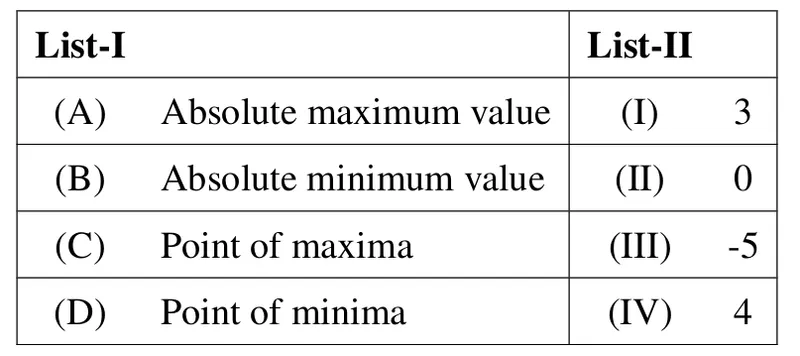
By analyzing the provided image, we see a table that lists several properties of a function under List-I, and corresponding values or points under List-II:
List-I:
(A) Absolute maximum value
(B) Absolute minimum value
(C) Point of maxima
(D) Point of minima
List-II:
(I) 3
(II) 0
(III) -5
(IV) 4
To determine the correct match, we analyze the function:
over the closed interval:
Step 1: Find the critical points of the function
We first compute the first derivative of the function with respect to :
Next, we set the derivative equal to zero to find the critical points:
Divide the entire equation by 6:
Factor the quadratic equation:
This gives the critical points:
and
Both of these critical points lie within the specified closed interval .
Step 2: Evaluate the function at the critical points and the boundaries
We evaluate the value of at the boundaries and , as well as at the critical points and :
1. At the boundary :
2. At the critical point :
3. At the critical point :
4. At the boundary :
Step 3: Determine the matches for List-I and List-II
(A) Absolute maximum value:
Comparing the function values , the largest value is .
Thus, the absolute maximum value is , which corresponds to (IV).
(B) Absolute minimum value:
Comparing the function values, the smallest value is .
Thus, the absolute minimum value is , which corresponds to (III).
(C) Point of maxima (Absolute Maxima):
The absolute maximum value of is achieved at .
Thus, the point of maxima is , which corresponds to (I).
(D) Point of minima (Absolute Minima):
The absolute minimum value of is achieved at .
Thus, the point of minima is , which corresponds to (II).
Combining all of the matches, we get:
(A) - (IV), (B) - (III), (C) - (I), (D) - (II)
Access expert-curated educational resources and study materials—completely free.
Create, conduct, and manage professional online assessments with Mindyard. Perfect for teachers and institutes.
Copyright © 2026 Mindyard. All Rights Reserved.