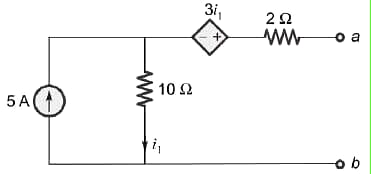
For the network shown, the equivalent Thevenin voltage and Thevenin impedance as seen across terminals ‘ab’ is
Correct Answer :
65 V in series with 15 Ω
Solution :
The correct option is 65 V in series with 15 Ω.
To find the equivalent Thevenin voltage () and Thevenin impedance/resistance () across terminals 'ab', we proceed with the following steps:
The Thevenin voltage is the open-circuit voltage across terminals 'ab' ().
When terminals 'ab' are open-circuited, no current flows through the resistor and the dependent voltage source.
Therefore, the entire current from the independent current source flows through the parallel resistor:
Let the node above the resistor be node and the bottom terminal be the reference node ().
The voltage at node is:
The dependent voltage source has a value of with the positive terminal on the right and the negative terminal on the left (connected to node ).
Since no current flows through the resistor, the voltage at terminal is the same as the voltage at the positive terminal of the dependent source:
Substituting the value of and :
To determine the Thevenin resistance, we deactivate the independent current source (replacing it with an open circuit) and apply a test current source entering terminal and leaving terminal .
Let be the voltage across terminals 'ab' due to the test current.
Since the independent current source is open-circuited, the current flows directly through the resistor, the dependent source, and downwards through the resistor.
This gives the relation:
Applying Kirchhoff's Voltage Law (KVL) along the path from terminal to terminal :
Substituting :
The equivalent Thevenin resistance is:
The equivalent Thevenin network consists of a voltage source of in series with an impedance/resistance of .
Access expert-curated educational resources and study materials—completely free.
Create, conduct, and manage professional online assessments with Mindyard. Perfect for teachers and institutes.
Copyright © 2026 Mindyard. All Rights Reserved.