For the reaction sequence given below, the correct statement(s) is(are)
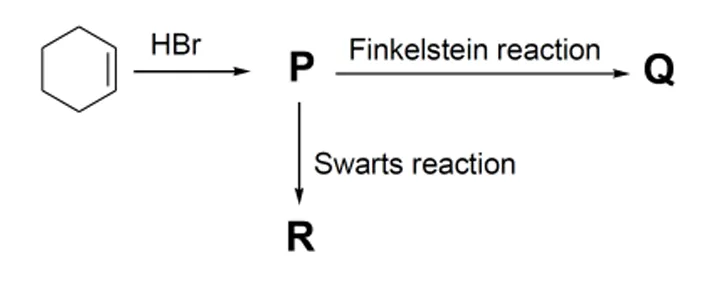
(In the options, X is any atom other than carbon and hydrogen, and it is different in P, Q and R)
Correct Answer :
C−X bond enthalpy in P, Q and R follows the order R > P > Q.
Solution :
The correct answer is: C−X bond enthalpy in P, Q and R follows the order R > P > Q.
To determine the correct statement, we must first identify the compounds P, Q, and R from the given reaction sequence:
Step 1: Formation of P
Cyclohexene reacts with via hydrohalogenation (electrophilic addition) to form P, which is bromocyclohexane.
Here, the substituent .
Step 2: Formation of Q
Bromocyclohexane (P) undergoes the Finkelstein reaction (typically using in acetone) to form Q, which is iodocyclohexane.
Here, the substituent .
Step 3: Formation of R
Bromocyclohexane (P) undergoes the Swarts reaction (typically using a metal fluoride such as ) to form R, which is fluorocyclohexane.
Here, the substituent .
Thus, we have:
P: Bromocyclohexane ( bond)
Q: Iodocyclohexane ( bond)
R: Fluorocyclohexane ( bond)
Now, let us evaluate the given options:
1. C−X Bond Length:
As we go down the halogen group (), the atomic size of the halogen increases. Consequently, the overlap between the orbital of carbon and the valence orbital of the halogen becomes poorer, leading to an increase in bond length.
The bond length order is:
Which corresponds to the order: Q > P > R.
Thus, Option A is incorrect.
2. C−X Bond Enthalpy:
Bond enthalpy is inversely proportional to bond length. Shorter bonds have stronger orbital overlap and thus higher bond dissociation energy (bond enthalpy).
The bond enthalpy order is:
Which corresponds to the order: R > P > Q.
Thus, Option B is correct.
3. Relative Reactivity toward SN2 Reaction:
In SN2 reactions, the rate of substitution is directly proportional to the leaving group ability of the halide. Since the weaker C−X bond is broken more easily, iodide is the best leaving group and fluoride is the poorest.
The reactivity order is:
Which corresponds to the order: Q > P > R.
Thus, Option C is incorrect.
4. pKa of the Conjugate Acids of the Leaving Groups:
The leaving groups are , , and . Their conjugate acids are , , and respectively.
Acid strength follows the order: .
Since , a stronger acid has a lower .
The order is:
Which corresponds to the order: R > P > Q.
Thus, Option D is incorrect.
Access expert-curated educational resources and study materials—completely free.
Create, conduct, and manage professional online assessments with Mindyard. Perfect for teachers and institutes.
Copyright © 2026 Mindyard. All Rights Reserved.