For the reaction sequence given below, the correct statement(s) is(are)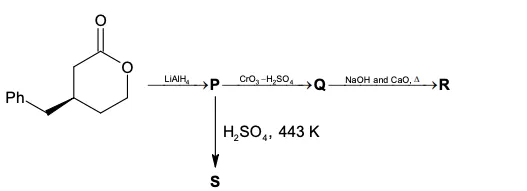
Correct Answer :
Q gives effervescence with aq. NaHCO3.
S gives Bayer’s test.
Solution :
The correct statements for the given reaction sequence are:
Q gives effervescence with aq. NaHCO3.
S gives Bayer’s test.
Let us analyze the reaction sequence step-by-step:
1. Structure of the Starting Material:
The starting material shown in the image is a 6-membered lactone (cyclic ester) with a benzyl group () at the 4-position: 4-benzyltetrahydro-2H-pyran-2-one.
2. Conversion of the Lactone to P:
Treating the lactone with a strong reducing agent like lithium aluminium hydride () reduces the cyclic ester group, opening the ring to yield a 1,5-diol:
The structure of P is:
This is 3-benzylpentane-1,5-diol. Because the central carbon atom is bonded to two identical 2-hydroxyethyl groups (), it is symmetric and lacks chiral centers. Thus, P is optically inactive.
3. Conversion of P to Q:
Jones reagent () oxidizes both primary alcohol groups of P to carboxylic acids:
The structure of Q is a dicarboxylic acid:
Since Q is a carboxylic acid, it reacts with aqueous sodium bicarbonate () to liberate carbon dioxide gas, producing effervescence:
Hence, the statement "Q gives effervescence with aq. NaHCO3" is correct.
4. Conversion of Q to R:
Heating Q with soda-lime () results in decarboxylation (removal of both carboxyl groups as carbon dioxide):
The structure of R is:
which is isopropylbenzene (cumene). Since cumene is an alkylbenzene (aromatic hydrocarbon) and not an alkyne, the statement "R is an alkyne" is incorrect.
5. Conversion of P to S:
Heating the diol P with concentrated sulfuric acid () at 443 K causes acid-catalyzed dehydration. The two primary alcohol groups undergo elimination to form carbon-carbon double bonds:
The structure of S is:
Because S is an alkene (diene), it contains carbon-carbon double bonds and therefore reacts positively to Bayer’s test (decolorization of cold, dilute, alkaline potassium permanganate solution). Hence, the statement "S gives Bayer’s test" is correct.
Access expert-curated educational resources and study materials—completely free.
Create, conduct, and manage professional online assessments with Mindyard. Perfect for teachers and institutes.
Copyright © 2026 Mindyard. All Rights Reserved.