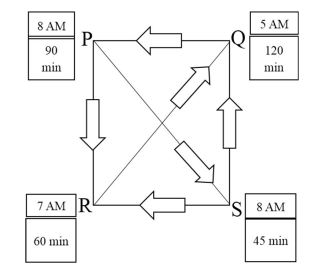
Four cities P, Q, R and S are connected through one-way routes as shown in the figure. The travel time between any two connected cities is one hour. The boxes beside each city name describe the starting time of first train of the day and their frequency of operation. For example, from city P, the first trains of the day start at 8 AM with a frequency of 90 minutes to each of R and S. A person does not spend additional time at any city other than the waiting time for the next connecting train. If the person starts from R at 7 AM and is required to visit S and return to R, what is the minimum time required ?
Solution :
The correct option is 6 hours 30 minutes.
To find the minimum time required to start from city R, visit city S, and return to city R, we must trace the one-way routes between the cities and determine the optimal schedule for the connecting trains. The travel time for each leg of the journey is 1 hour.
First, let's identify the allowed directions of travel based on the arrows shown in the figure:
- From R, the only outgoing route is to Q (indicated by the diagonal arrow pointing up and to the right).
- From Q, the only outgoing route is to P (indicated by the horizontal arrow pointing left).
- From P, there are outgoing routes to R (downward arrow) and to S (diagonal arrow pointing down and to the right). since we must visit S, we will proceed to S.
- From S, we can return to R via the horizontal arrow pointing left.
Thus, the shortest path to visit S and return to R is:
R → Q → P → S → R
Now, let's calculate the timeline of the journey step-by-step starting at 7:00 AM from R:
Step 1: Travel from R to Q
- The first train of the day from R starts at 7:00 AM and runs with a frequency of 60 minutes (every hour).
- Since the person starts at 7:00 AM, they can immediately catch the 7:00 AM train.
- Travel time is 1 hour, so they arrive at Q at:
Step 2: Travel from Q to P
- Trains from Q start at 5:00 AM and run every 120 minutes (2 hours). The departure schedule from Q is:
- The person arrives at Q at 8:00 AM. The next available train departs at 9:00 AM.
- Waiting time at Q is 1 hour.
- Boarding the 9:00 AM train, they arrive at P at:
Step 3: Travel from P to S
- Trains from P start at 8:00 AM and run every 90 minutes (1.5 hours). The departure schedule from P is:
- The person arrives at P at 10:00 AM. The next available train departs at 11:00 AM.
- Waiting time at P is 1 hour.
- Boarding the 11:00 AM train, they arrive at S at:
Step 4: Travel from S to R
- Trains from S start at 8:00 AM and run every 45 minutes. The departure schedule from S is:
- The person arrives at S at 12:00 PM. The next available train departs at 12:30 PM.
- Waiting time at S is 30 minutes.
- Boarding the 12:30 PM train, they arrive back at R at:
Conclusion: Total Time Calculation
- Start time at R: 7:00 AM
- Return time at R: 1:30 PM
- The total minimum time elapsed is:
Completely free for students. Educators & coaching institutes get 2 months free Pro trial to create tests.
Access unlimited practice questions, detailed step-by-step solutions, and exam study materials — completely free for students.
Create and conduct professional online assessments with AI question generation, tab proctoring, and comprehensive batch management.
SSC CHSL Tier-1 Shift 1 2 July 2024 question paper with answers and detailed solutions. This practice paper covers questions from General Intelligence & Reasoning, General Awareness, Quantitative Aptitude, and English Language as asked in the SSC CHSL Tier-1 examination. Practice the SSC CHSL 2 July 2024 Shift 1 paper to understand the exam pattern, question types, difficulty level, and important topics for upcoming SSC CHSL exams.

SSC CHSL Tier-1 Shift 2 held on 2 July 2024 question paper with answers and detailed solutions. This previous year paper covers General Intelligence & Reasoning, Quantitative Aptitude, General Awareness, and English Language. The SSC CHSL Tier-1 exam was conducted in CBT mode with 100 questions for 200 marks and a 60-minute duration.
Copyright © 2026 Combe Labs Private Limited. All Rights Reserved.