Four identical thin, square metal sheets, 𝑆1, 𝑆2, 𝑆3 and 𝑆4, each of side 𝑎 are kept parallel to each other with equal distance 𝑑 (≪ 𝑎) between them, as shown in the figure. Let 𝐶0 = 𝜀0𝑎2/𝑑, where 𝜀0 is the permittivity of free space.
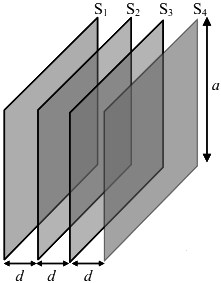
Match the quantities mentioned in List-I with their values in List-II and choose the correct option.
| List-I | List-II |
| (P) The capacitance between 𝑆1 and 𝑆4, with 𝑆2 and 𝑆3 not connected, is |
(1) 3𝐶0 |
| (Q) The capacitance between 𝑆1 and 𝑆4, with 𝑆2 shorted to 𝑆3, is |
(2) 𝐶0/2 |
| (R) The capacitance between 𝑆1 and 𝑆3, with 𝑆2 shorted to 𝑆4, is |
(3) 𝐶0/3 |
| (S) The capacitance between 𝑆1 and 𝑆2, with 𝑆3 shorted to 𝑆1, and 𝑆2 shorted to 𝑆4, is |
(4) 2𝐶0/3 |
| (5) 2𝐶0 |
Correct Answer :
P → 3; Q → 2; R → 4; S → 1
Solution :
The correct option is P → 3; Q → 2; R → 4; S → 1.
Let us consider the four parallel square metal sheets 𝑆1, 𝑆2, 𝑆3, and 𝑆4 shown in the figure. The area of each sheet is 𝑎2 and the separation between consecutive sheets is 𝑑. The capacitance of a single region formed by two adjacent plates separated by distance 𝑑 is given by:
The system consists of three individual identical capacitors in series sequence:
- Capacitor 𝐶12 between plates 𝑆1 and 𝑆2, with capacitance 𝐶0.
- Capacitor 𝐶23 between plates 𝑆2 and 𝑆3, with capacitance 𝐶0.
- Capacitor 𝐶34 between plates 𝑆3 and 𝑆4, with capacitance 𝐶0.
Now, let us analyze each case given in List-I step-by-step:
(P) Capacitance between 𝑆1 and 𝑆4 with 𝑆2 and 𝑆3 not connected:
When 𝑆2 and 𝑆3 are isolated (unconnected), the three capacitors formed between adjacent plates (𝑆1-𝑆2, 𝑆2-𝑆3, and 𝑆3-𝑆4) are connected in series between terminal 𝑆1 and terminal 𝑆4.
The equivalent capacitance 𝐶eq is:
Thus, P → 3.
(Q) Capacitance between 𝑆1 and 𝑆4 with 𝑆2 shorted to 𝑆3:
When 𝑆2 and 𝑆3 are shorted together, they are at the same electric potential. This means there is no potential difference across the middle gap between 𝑆2 and 𝑆3, so capacitor 𝐶23 carries no net energy stored across its potential gap and effectively acts as a conducting link between the remaining gaps.
The system reduces to two capacitors in series: 𝐶12 (between 𝑆1 and 𝑆2) and 𝐶34 (between 𝑆3 and 𝑆4).
Thus, Q → 2.
(R) Capacitance between 𝑆1 and 𝑆3 with 𝑆2 shorted to 𝑆4:
Let the potential of terminal 𝑆1 be 𝑉1 and terminal 𝑆3 be 𝑉3.
Since 𝑆2 and 𝑆4 are shorted, let their common potential be 𝑉2.
- Capacitor 𝐶12 (between 𝑆1 and 𝑆2) has potential difference |𝑉1 - 𝑉2|.
- Capacitor 𝐶23 (between 𝑆2 and 𝑆3) has potential difference |𝑉3 - 𝑉2|.
- Capacitor 𝐶34 (between 𝑆3 and 𝑆4) has potential difference |𝑉3 - 𝑉2|.
Notice that 𝐶23 and 𝐶34 are connected in parallel between potential 𝑉3 and 𝑉2, giving a combined capacitance of:
This parallel combination (2𝐶0) is in series with capacitor 𝐶12 (𝐶0) across terminals 𝑆1 and 𝑆3:
Thus, R → 4.
(S) Capacitance between 𝑆1 and 𝑆2 with 𝑆3 shorted to 𝑆1 and 𝑆2 shorted to 𝑆4:
Here:
- Terminal A connects 𝑆1 and 𝑆3 together.
- Terminal B connects 𝑆2 and 𝑆4 together.
Let us analyze the three gaps between terminals A and B:
1. Gap between 𝑆1 (Terminal A) and 𝑆2 (Terminal B): forms capacitor 𝐶12 = 𝐶0.
2. Gap between 𝑆2 (Terminal B) and 𝑆3 (Terminal A): forms capacitor 𝐶23 = 𝐶0.
3. Gap between 𝑆3 (Terminal A) and 𝑆4 (Terminal B): forms capacitor 𝐶34 = 𝐶0.
All three individual capacitors are connected directly in parallel across Terminals A and B.
The net equivalent capacitance is:
Thus, S → 1.
Combining all the matches:
P → 3, Q → 2, R → 4, S → 1.
Access expert-curated educational resources and study materials—completely free.
Create, conduct, and manage professional online assessments with Mindyard. Perfect for teachers and institutes.
Copyright © 2026 Mindyard. All Rights Reserved.