Gene expresses itself in a cell system as a protein/enzyme. How does an expression of gene occur in a cell system and when does it need to occur, and how the gene expression is regulated in a prokaryote cell system was studied by the combined efforts of Jacque Monod, the biochemist and Francois Jacob, the geneticist. For their work on lactose metabolism in E. coli and introducing the concept of "lac operon" they were awarded the Nobel Prize in 1965.
(a) Why is lac operon said to be a transcriptionally regulated system ?
(b) It is said that the lac operon has to be operational at a very low level in the bacterial cell all the time. Justify.
(c) Why is the regulator gene in lac operon marked as 'i' gene ?
(d) Draw a schematic diagram of lac operon in absence of inducer in the culture medium of the bacteria.
or
(d) Draw a schematic diagram of lac operon in the presence of inducer in the culture medium of the bacteria.
Correct Answer :
(a) In presence of lactose repressor protein dose not bind to the operator region (O) and allow RNA polymerase to transcribe the operon.
//
In absence of lactose repressor protein bind to the operator region (O) and prevent RNA polymerase from transcribing the operon.
(b) Presence of Permease enzyme coded by gene ‘y’ is required that allows lactose to enter the cell for switching on the operon / so that lactose enter inside the cell.
(c) ‘i’ stands for ‘inhibitor/ this gene transcribes repressor protein which binds to the ‘operator’ site and switch off the operon.
(d)
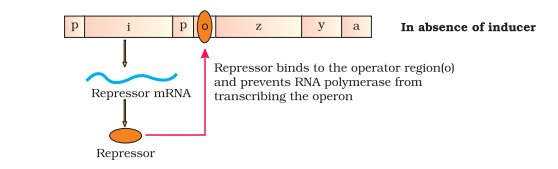
or
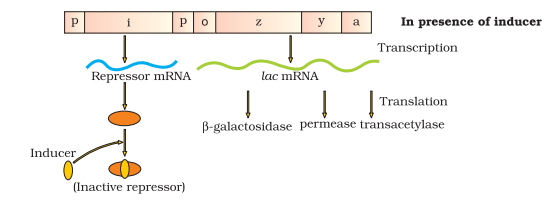
Solution :
Correct Answer:
(a) In the presence of lactose, the repressor protein does not bind to the operator region (O), allowing RNA polymerase to transcribe the operon. In the absence of lactose, the repressor protein binds to the operator region (O) and prevents RNA polymerase from transcribing the operon.
(b) The presence of the permease enzyme (coded by the y gene) is required to allow lactose to enter the cell so that the operon can be switched on. Thus, the operon must be operational at a very low level at all times.
(c) The letter 'i' stands for inhibitor. This regulatory gene transcribes the repressor protein, which binds to the operator site and switches off the operon.
(d) The schematic diagram representing the lac operon in the absence of an inducer (where the repressor binds to the operator and blocks transcription) or in the presence of an inducer (where the inducer inactivates the repressor, enabling transcription of the structural genes to produce β-galactosidase, permease, and transacetylase).
Detailed Step-by-Step Explanation:
Part (a): Transcriptional Regulation of the Lac Operon
The lac operon is described as a transcriptionally regulated system because its control is exercised at the level of transcription initiation (the synthesis of mRNA from DNA).
1. In the absence of an inducer: As observed in the first diagram (labeled "In absence of inducer"), the regulatory gene (labeled i) is transcribed into Repressor mRNA, which is then translated to produce an active Repressor protein. This repressor binds specifically to the operator region (labeled o). The physical binding of the repressor at the operator site blocks the promoter region, preventing RNA polymerase from binding and transcribing the downstream structural genes (z, y, and a).
2. In the presence of an inducer: As shown in the second diagram (labeled "In presence of inducer"), when an inducer (such as lactose or allolactose) is present, it binds directly to the repressor protein. This binding causes a conformational change, forming an (Inactive repressor) complex. The inactive repressor is unable to bind to the operator region (o). Consequently, the operator remains free, allowing RNA polymerase to bind to the promoter (p) and initiate the transcription of lac mRNA.
Part (b): Constant Low-Level Operation of the Operon
For the lac operon to be switched on in the first place, lactose must first enter the bacterial cell from the external culture medium.
The transport of lactose across the cell membrane into the cytoplasm is facilitated by the transport protein/enzyme called permease, which is coded by the structural gene y.
If the lac operon were completely shut down with zero expression, there would be no permease molecules present on the cell membrane, meaning lactose could never enter the cell to bind to the repressor and induce transcription. Therefore, the operon must always function at a basal, very low level in the cell to maintain a minimum number of permease molecules, ensuring that lactose can enter and initiate the induction process.
Part (c): Significance of the 'i' Gene Label
A common misconception is that the 'i' in the regulator gene stands for "inducer". However, the term 'i' actually stands for inhibitor. This is because the primary function of this regulatory gene is to produce a repressor protein that inhibits or prevents transcription, thereby acting as a negative regulator that switches off the operon under default conditions (when lactose is absent).
Part (d): Explanation of the Schematic Diagrams
The two provided diagrams illustrate the molecular switch mechanism of the operon:
• Absence of Inducer (Diagram 1): Shows the promoter (p) and regulator gene (i) followed by the operator (o) and the structural genes (z, y, a). The i gene transcribes Repressor mRNA to produce the Repressor protein, which binds to the operator region (o) and prevents RNA polymerase from transcribing the operon.
• Presence of Inducer (Diagram 2): Illustrates that when the Inducer binds to the repressor, it creates an (Inactive repressor) that cannot bind to the operator (o). This allows transcription of the structural genes to yield lac mRNA, which is then translated into the three enzymes: β-galactosidase (from gene z), permease (from gene y), and transacetylase (from gene a).
Access expert-curated educational resources and study materials—completely free.
Create, conduct, and manage professional online assessments with Mindyard. Perfect for teachers and institutes.
Copyright © 2026 Mindyard. All Rights Reserved.
 Set - 3-1782888548748.webp)