Gene expresses itself in a cell system as a protein/enzyme. How does an expression of gene occur in a cell system and when does it need to occur, and how the gene expression is regulated in a prokaryote cell system was studied by the combined efforts of Jacque Monod, the biochemist and Francois Jacob, the geneticist. For their work on lactose metabolism in E. coli and introducing concept of "lac operon" they were awarded the Nobel Prize in 1965.
(a) Why is lac operon said to be a transcriptionally regulated system?
(b) It is said that "the lac operon has to be operational at a very low level in the bacterial cell all the time." Justify.
(c) Why is the regulator gene in lac operon marked as 'i' gene?
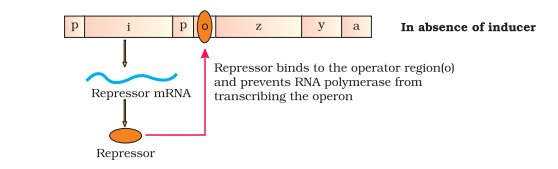
(d) Draw a schematic diagram of lac operon in absence of inducer in the culture medium of the bacteria.
or
(d) Draw a schematic diagram of lac operon in the presence of inducer in the culture medium of the bacteria
Correct Answer :
(a) In presence of lactose repressor protein dose not bind to the operator region (O) and allow RNA polymerase to transcribe the operon.
//
In absence of lactose repressor protein bind to the operator region (O) and prevent RNA polymerase from transcribing the operon.
(b) Presence of Permease enzyme coded by gene ‘y’ is required that allows lactose to enter the cell for switching on the operon / so that lactose enter inside the cell.
(c) ‘i’ stands for ‘inhibitor/ this gene transcribes repressor protein which binds to the ‘operator’ site and switch off the operon.
(d)
or
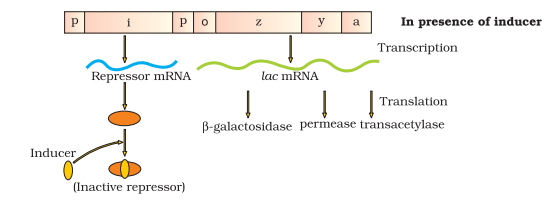
Solution :
Correct Answer / Option:
(a) In the presence of lactose, the repressor protein does not bind to the operator region (O), allowing RNA polymerase to transcribe the operon. In the absence of lactose, the repressor protein binds to the operator region (O) and prevents RNA polymerase from transcribing the operon.
(b) The presence of the permease enzyme, coded by gene y, is required to allow lactose to enter the cell for switching on the operon (so that lactose can enter inside the cell).
(c) The letter 'i' stands for 'inhibitor'. This gene transcribes the repressor protein which binds to the 'operator' site and switches off the operon.
(d) The schematic diagrams representing the regulation of the lac operon in the absence and presence of an inducer are described below.
Detailed Step-by-Step Explanation:
(a) Transcriptional Regulation of the Lac Operon
The lac operon is regulated at the transcriptional level because the cell controls whether the structural genes are transcribed into messenger RNA (mRNA) based on the presence of the substrate (lactose).
1. In the absence of the inducer (lactose): The regulator gene (i gene) undergoes transcription and translation to produce an active repressor protein. This repressor binds directly to the operator region (O). This physical block prevents RNA polymerase from transcribing the structural genes (z, y, and a).
2. In the presence of the inducer (lactose): Lactose (or its isomer allolactose) acts as an inducer. As visualized in the second image labeled "In presence of inducer", the inducer (yellow oval shape) binds to the repressor protein (orange oval shape), forming an inactive repressor. This conformational change prevents the repressor from binding to the operator region. Consequently, RNA polymerase binds to the promoter and transcribes the structural genes into a polycistronic lac mRNA (shown as the green wavy line in the diagram).
(b) Role of Low-Level Basal Expression
Lactose is a polar molecule and cannot pass through the hydrophobic bacterial cell membrane by simple diffusion. It requires a transport protein called permease (which is coded by the structural gene y of the operon) to enter the cell. If the operon were completely shut down with zero transcription, no permease would be present, and lactose could never enter the cell to initiate induction. Therefore, a very low level of operon expression must occur at all times to maintain a basal concentration of permease on the cell membrane, allowing the initial entry of lactose when it is added to the culture medium.
(c) The Significance of the 'i' Gene
The regulatory gene is designated as the i gene where 'i' stands for inhibitor (and not inducer). This nomenclature is used because the primary function of this gene's product (the repressor protein) is to inhibit the transcription of the operon under default conditions by blocking the operator site.
(d) Schematic Representations
The sequence of regulatory and structural elements in the lac operon DNA can be represented schematically as:
where 'p' represents promoters, 'i' represents the inhibitor gene, 'o' represents the operator, and 'z', 'y', and 'a' represent the structural genes.
1. Schematic in the absence of inducer:
- The i gene is transcribed into repressor mRNA, which translates into the active repressor protein.
- The active repressor protein binds to the operator (o), preventing RNA polymerase transcription.
- No lac mRNA is synthesized, and no structural enzymes are produced.
2. Schematic in the presence of inducer (as shown in the second image):
- The i gene is transcribed into repressor mRNA, which is translated to the repressor protein.
- The inducer binds to the repressor protein, rendering it inactive:
- The inactive repressor is unable to bind to the operator (o).
- RNA polymerase transcribes the structural genes into lac mRNA.
- The lac mRNA is translated into three functional enzymes:
• β-galactosidase (from the z gene) – hydrolyzes lactose into glucose and galactose.
• permease (from the y gene) – increases the permeability of the cell to β-galactosides.
• transacetylase (from the a gene) – catalyzes the transfer of an acetyl group to β-galactosides.
Access expert-curated educational resources and study materials—completely free.
Create, conduct, and manage professional online assessments with Mindyard. Perfect for teachers and institutes.
Copyright © 2026 Mindyard. All Rights Reserved.
 Set - 3-1782888548748.webp)