
Given below are two statements based on the structures shown.
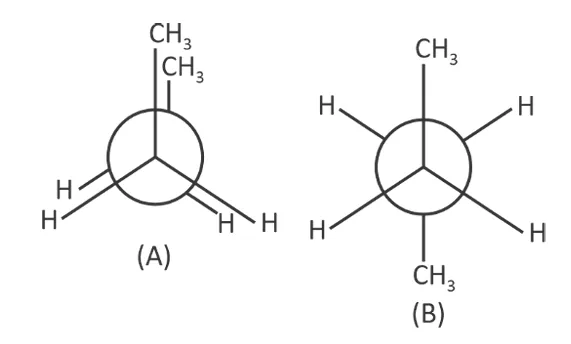
Statement I: B is more stable than A.
Statement II: Dihedral angle of B is more than A.
Choose the correct option.
Solution :
The correct option is Both statement I and statement II are correct.
Let us analyze the two structures shown in the image:
Structure A: Represents the fully eclipsed conformation of butane. In this conformation, the two methyl () groups on adjacent carbons lie directly behind one another. The dihedral angle () between the two methyl groups is:
This structure experiences maximum torsional strain (due to eclipsing C-H and C-C bonds) and steric hindrance (due to the close proximity of bulky methyl groups), making it the least stable conformation.
Structure B: Represents the anti-conformation (staggered) of butane. In this conformation, the two methyl () groups are positioned as far apart as possible. The dihedral angle () between the two methyl groups is:
This conformation minimizes both steric hindrance and torsional strain, making it the most stable conformation of butane.
Now, let us evaluate the given statements:
Statement I: B is more stable than A.
Since staggered/anti conformations (B) have lower potential energy due to minimized steric and torsional strain compared to fully eclipsed conformations (A), conformation B is much more stable than conformation A. Thus, Statement I is correct.
Statement II: Dihedral angle of B is more than A.
The dihedral angle of conformation B is , and the dihedral angle of conformation A is . Since:
the dihedral angle of B is indeed greater than that of A. Thus, Statement II is also correct.
Therefore, both Statement I and Statement II are correct.
Completely free for students. Educators & coaching institutes get 2 months free Pro trial to create tests.
Access unlimited practice questions, detailed step-by-step solutions, and exam study materials — completely free for students.
Create and conduct professional online assessments with AI question generation, tab proctoring, and comprehensive batch management.

A comprehensive JEE Advanced 2022 Paper 1 designed to help aspirants understand the examination pattern, difficulty level, and question trends of JEE Advanced. This paper covers important concepts from Physics, Chemistry, and Mathematics, featuring a balanced mix of conceptual, numerical, and advanced application-based questions. It helps students strengthen conceptual understanding, enhance analytical and problem-solving skills, and improve speed and accuracy. Ideal for practice, revision, self-assessment, previous year trend analysis, concept reinforcement, and time management, this paper is a valuable resource for effective JEE Advanced preparation.

A comprehensive JEE Advanced 2022 Paper 2 designed to help aspirants understand the examination pattern, difficulty level, and question trends of JEE Advanced. This paper covers important concepts from Physics, Chemistry, and Mathematics, featuring a balanced mix of conceptual, numerical, and advanced application-based questions. It helps students strengthen conceptual understanding, enhance analytical and problem-solving skills, and improve speed and accuracy. Ideal for practice, revision, self-assessment, previous year trend analysis, concept reinforcement, and time management, this paper is a valuable resource for effective JEE Advanced preparation.
Copyright © 2026 Combe Labs Private Limited. All Rights Reserved.


