Given below are two statements:
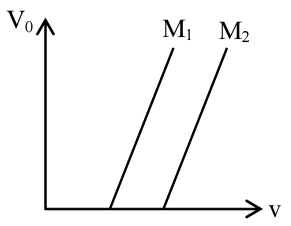
Statement-I: Figure shows the variation of stopping potential with frequency (v) for the two photosensitive materials M1 and M2. The slope gives value of h e , where h is Planck's constant, e is the charge of electron.
Statement-II: M2 will emit photoelectrons of greater kinetic energy for the incident radiation having same frequency.
In the light of the above statements, choose the most appropriate answer from the options given below.
Correct Answer :
Statement-I is correct and Statement-II is incorrect.
Solution :
The correct answer is: Statement-I is correct and Statement-II is incorrect.
To evaluate both statements, we must use Einstein's Photoelectric Equation and carefully analyze the graph described in the question.
Understanding the Graph:
The image shows a V₀ vs. v (stopping potential vs. frequency) graph with two straight lines — one for photosensitive material M₁ and one for M₂. The two lines are parallel to each other (same slope), but M₂'s line is shifted to the right of M₁'s line, meaning M₂ has a higher threshold frequency (v₀) and therefore a higher work function (φ).
Einstein's Photoelectric Equation:
Rearranging for stopping potential V₀:
This is a linear equation of the form y = mx + c, where:
- The slope = (Planck's constant / charge of electron)
- The y-intercept = (depends on the work function of the material)
Evaluating Statement-I:
Statement-I says that the slope of the V₀ vs. v graph gives the value of . From the equation above, this is exactly correct. The slope is , which is a universal constant (Planck's constant divided by elementary charge). This is independent of the material, which is why both lines in the graph are parallel — they have the same slope. Statement-I is correct.
Evaluating Statement-II:
Statement-II claims that M₂ will emit photoelectrons of greater kinetic energy than M₁ for the same incident frequency.
From the graph, M₂'s line is positioned to the right of M₁'s line. This means M₂ has a higher threshold frequency v₀, and thus a higher work function φ₂ > φ₁.
The maximum kinetic energy of emitted photoelectrons is:
For the same incident frequency v, a material with a higher work function φ will result in lower kinetic energy of the emitted photoelectrons:
So, M₂ emits photoelectrons with less kinetic energy (not greater) compared to M₁, for the same incident frequency. Statement-II is incorrect.
Conclusion: Statement-I is correct (slope = h/e is a universal constant, same for all materials) and Statement-II is incorrect (M₂ has a higher work function and thus emits photoelectrons with lower kinetic energy for the same frequency compared to M₁).
Access expert-curated educational resources and study materials—completely free.
Create, conduct, and manage professional online assessments with Mindyard. Perfect for teachers and institutes.
Copyright © 2026 Mindyard. All Rights Reserved.