Given below are two statements:
Statement (I): If the length of a psychological test is increased it improves both reliability and validity.
Statement (II): Score of a test can be interpreted without referring to its norm.
In the light of the above statements, choose the most appropriate answer from the options given helow:
Solution :
The correct option is: Statement (I) is correct, but statement (II) is incorrect.
Analysis of Statement (I):
In psychometrics, increasing the length of a test (i.e., adding more homogeneous or parallel items) generally increases its reliability. This relationship is mathematically described by the Spearman-Brown prophecy formula, which demonstrates that adding more items reduces random measurement error, thereby increasing the consistency (reliability) of the test scores. Since validity is theoretically capped by reliability (a test cannot be valid if it is not reliable), improving reliability also provides a necessary foundation for improving validity. If the new items are representative of the construct being measured, the test covers a broader domain of the content, which directly enhances content and construct validity. Thus, Statement (I) is correct.
Analysis of Statement (II):
A raw score on a psychological test (for example, scoring 45 out of 60) is typically meaningless on its own because it does not indicate how an individual performs relative to a reference group. To interpret psychological test scores meaningfully, they must be compared against a standardization sample or "norm" (norm-referenced interpretation) or against a pre-established performance standard (criterion-referenced interpretation). Interpreting a standard psychological test score without any norm or reference framework is not clinically or educationally useful. Thus, Statement (II) is incorrect.
Completely free for students. Educators & coaching institutes get 2 months free Pro trial to create tests.
Access unlimited practice questions, detailed step-by-step solutions, and exam study materials — completely free for students.
Create and conduct professional online assessments with AI question generation, tab proctoring, and comprehensive batch management.
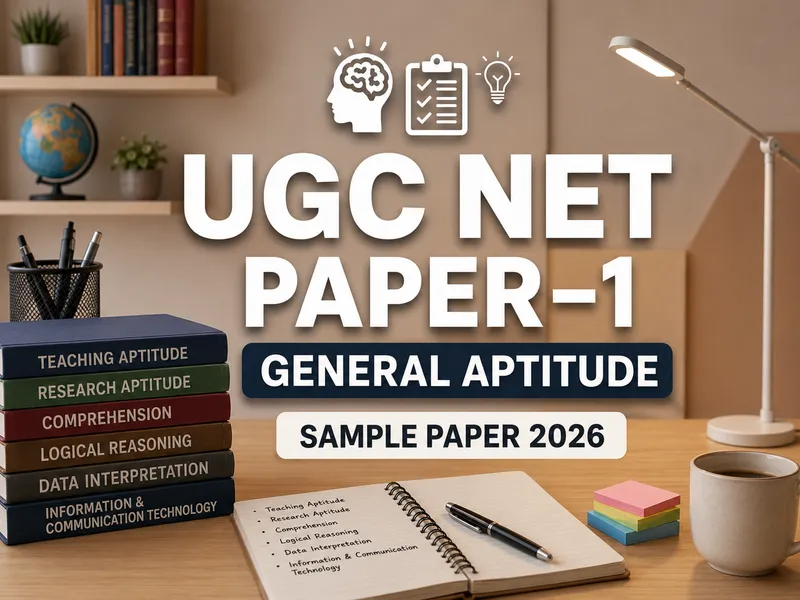
The UGC NET Paper–1 General Aptitude Sample Paper is a well-structured practice resource designed to help aspirants prepare effectively for the Paper–1 section of the UGC NET. This sample paper covers all key areas including Teaching Aptitude, Research Aptitude, Logical Reasoning, Data Interpretation, Communication, ICT, Higher Education System, and People & Environment. Prepared according to the latest exam pattern, it features a balanced mix of conceptual, analytical, and application-based multiple-choice questions. The paper is designed to simulate real exam conditions, helping candidates improve accuracy, speed, and time management. Ideal for both beginners and advanced learners, this sample paper enables aspirants to evaluate their preparation level, identify weak areas, and strengthen core concepts for better performance in the actual UGC NET examination.
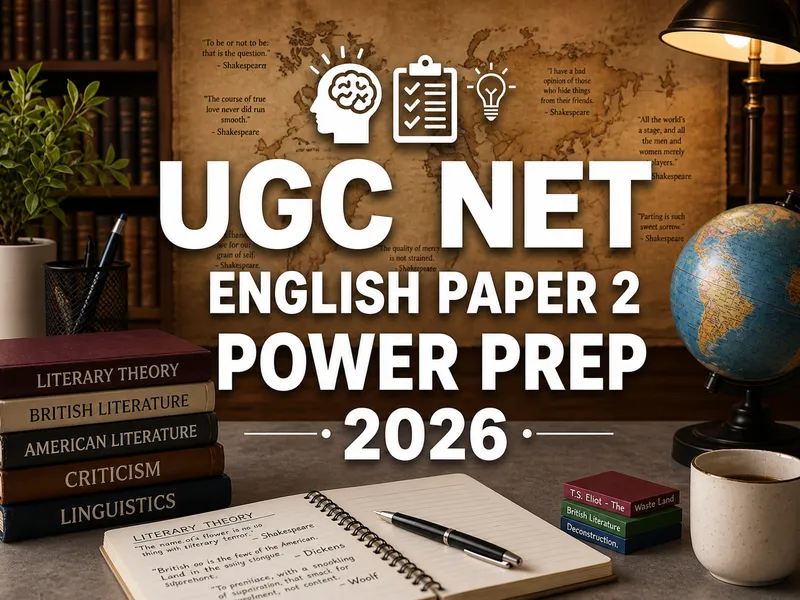
Master your preparation with a focused and exam-oriented program designed specifically for UGC NET English Paper 2. This course helps you build deep conceptual clarity and strong analytical skills required to excel in literature and language-based questions.
Copyright © 2026 Combe Labs Private Limited. All Rights Reserved.