Given below are two statements:
Statement I: In a ratio scale, zero point is arbitrary
Statement II: The nominal scale allows ordering/ranking of data
In the light of the above statements, choose the most appropriate answer from the options given below:
Solution :
The correct option is Both Statement I and Statement II are false.
Let us analyze each statement step-by-step to understand why they are incorrect:
Analysis of Statement I: "In a ratio scale, zero point is arbitrary"
A ratio scale is the highest level of measurement. It possesses all the properties of nominal, ordinal, and interval scales, with the addition of a true (absolute) zero point. A true zero point indicates the complete absence of the property being measured (for example, zero weight means no weight, and zero income means no income). This allows us to compare the ratios of measurements (e.g., 10 kg is twice as heavy as 5 kg). Because the zero point in a ratio scale is absolute and not arbitrary (unlike in an interval scale, such as the Celsius temperature scale where 0°C does not mean the absence of heat), Statement I is false.
Analysis of Statement II: "The nominal scale allows ordering/ranking of data"
A nominal scale is the simplest level of measurement, used solely for labeling or categorizing data into mutually exclusive groups (e.g., gender, eye color, or political party affiliation). It does not imply any quantitative value, order, or ranking among the categories. The scale that allows ordering or ranking of data is the ordinal scale (e.g., first place, second place, third place). Since the nominal scale does not allow for any ordering or ranking, Statement II is false.
Therefore, both Statement I and Statement II are false.
Completely free for students. Educators & coaching institutes get 2 months free Pro trial to create tests.
Access unlimited practice questions, detailed step-by-step solutions, and exam study materials — completely free for students.
Create and conduct professional online assessments with AI question generation, tab proctoring, and comprehensive batch management.
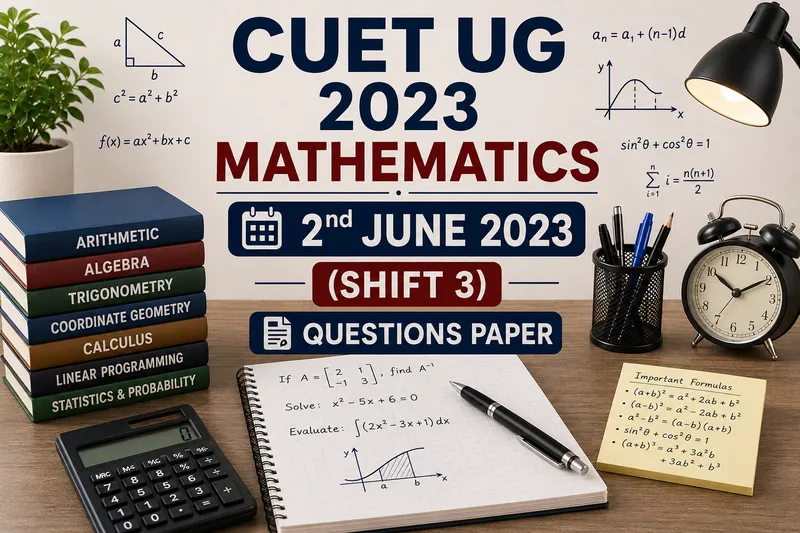
A comprehensive CUET UG Mathematics Question Paper with Solutions – 2 June 2023 (Shift 3) designed to help students practice and understand the actual CUET exam pattern. This paper covers important topics from Algebra, Calculus, Coordinate Geometry, Probability, Statistics, Matrices, Determinants, and Vectors, featuring a balanced mix of conceptual, numerical, and application-based questions. Detailed solutions are provided to strengthen problem-solving skills, improve conceptual clarity, and enhance calculation accuracy. Based on the CUET syllabus and previous year exam trends, this paper is ideal for practice, revision, self-assessment, time management, previous year analysis, and final preparation for upcoming CUET UG Mathematics examinations.
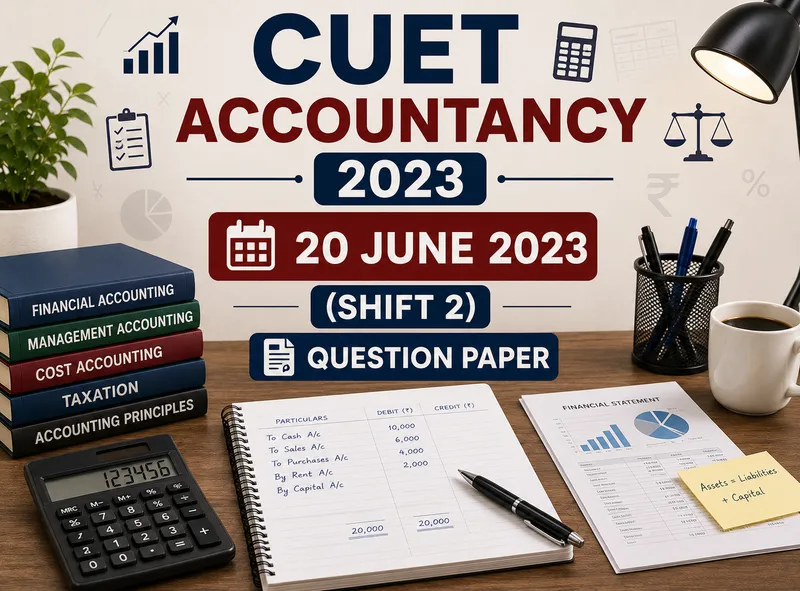
A comprehensive CUET Accountancy Question Paper – 20 June 2023 (Shift 2) designed to help students practice and analyze previous year exam patterns for effective CUET preparation. This paper covers important topics including Accounting for Partnership Firms, Company Accounts, Financial Statements Analysis, Cash Flow Statements, Accounting Ratios, and Fundamental Accounting Principles. It features a balanced mix of conceptual, numerical, and application-based questions to strengthen accounting concepts, improve calculation accuracy, and enhance problem-solving skills. Based on the CUET exam structure and syllabus, this paper is ideal for practice, revision, self-assessment, time management, previous year analysis, and final preparation for upcoming CUET Accountancy examinations.
Copyright © 2026 Combe Labs Private Limited. All Rights Reserved.