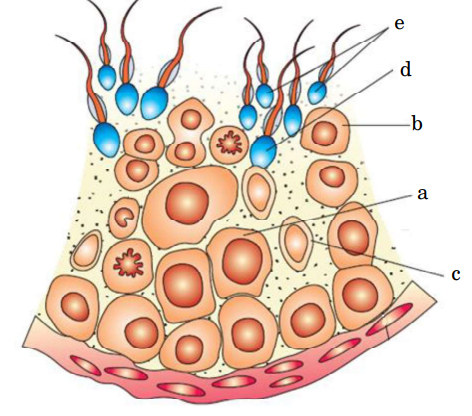
Given below is a diagrammatic sectional view of a seminiferous tubule. State the developmental process of :
(a)
i) 'b' from 'a'.
ii) 'e' from 'd'.
iii) 'd' from 'b'.
(b) Identify 'a', 'b' and 'c'.
Correct Answer :
(a)
i) ‘b’ (secondary spermatocytes) formed after first meiotic division/Meiosis -I in ‘a’ (primary spermatocytes)
ii) ‘e’ (sperms) formed via a process called spermiogenesis/differentiation from ‘d’ (spermatids)
iii) ‘d’ (Spermatids) formed after second meiotic division/ Meiosis- II from ‘b’ ( secondary spermatocyte).
(b)
a – Primary spermatocyte
b – Secondary spermatocyte
c – Sertoli cell
Solution :
Correct Answer:
(a)
i) ‘b’ (secondary spermatocytes) formed after first meiotic division (Meiosis-I) in ‘a’ (primary spermatocytes).
ii) ‘e’ (sperms) formed via a process called spermiogenesis/differentiation from ‘d’ (spermatids).
iii) ‘d’ (spermatids) formed after second meiotic division (Meiosis-II) from ‘b’ (secondary spermatocyte).
(b)
a – Primary spermatocyte
b – Secondary spermatocyte
c – Sertoli cell
Step-by-step Explanation:
Part (a): Developmental Processes
Spermatogenesis is the sequence of events by which spermatogonia develop into mature spermatozoa. By analyzing the provided diagrammatic sectional view of a seminiferous tubule, we can trace the development of these male germ cells step-by-step:
i) Development of ‘b’ from ‘a’:
The cell labeled ‘a’ is a primary spermatocyte. It is a diploid (2n) cell that undergoes the first meiotic division (Meiosis-I), which is a reductional division. This division results in the formation of two equal, haploid (n) cells called secondary spermatocytes, labeled as ‘b’. Therefore, ‘b’ is formed after Meiosis-I in ‘a’.
ii) Development of ‘e’ from ‘d’:
The cells labeled ‘d’ are spermatids, which are non-motile, spherical haploid cells. To become functional male gametes, they must transform into flagellated, motile spermatozoa (sperms), labeled as ‘e’. This process of transformation of spermatids into spermatozoa is known as spermiogenesis (or differentiation).
iii) Development of ‘d’ from ‘b’:
The secondary spermatocytes (labeled ‘b’) undergo the second meiotic division (Meiosis-II), which is an equational division. This division splits the sister chromatids, yielding four haploid spermatids (labeled ‘d’) from the initial primary spermatocyte lineage. Thus, ‘d’ is formed from ‘b’ via Meiosis-II.
Part (b): Identification of Cells
By looking at the histology of the seminiferous tubule in the image:
• a represents the larger germ cells undergoing the first stage of meiosis, which are the Primary spermatocytes.
• b represents the smaller cells situated closer to the lumen that result from the first division, which are the Secondary spermatocytes.
• c points to the elongated, pyramidal cell that provides nourishment and structural support to the developing germ cells, known as the Sertoli cell.
Access expert-curated educational resources and study materials—completely free.
Create, conduct, and manage professional online assessments with Mindyard. Perfect for teachers and institutes.
Copyright © 2026 Mindyard. All Rights Reserved.
 Set - 3-1782888548748.webp)