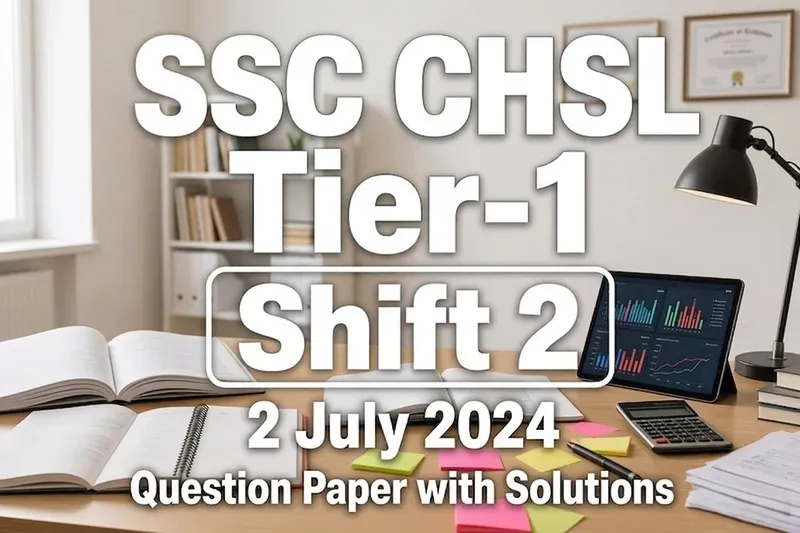
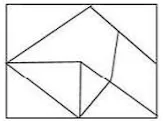
Given figure is embedded in any one of the four option figures. Find the option figure which contains the given figure as its part.
 .
.
Options
 .
.
 .
.
 .
.
 .
.
Correct Answer :
.
Solution :
The correct answer is Option 4.
This is a Figure Embedding (Hidden Figure) question. The task is to identify which of the four option figures contains the given figure as a hidden part within it, without altering its shape, size, or orientation.
Step 1: Carefully Analyze the Given Figure (image_0)
The given figure is an irregular pentagon (a 5-sided closed shape). Examining it closely:
- The bottom-left side is a long diagonal line slanting from the lower-left corner upward to the right.
- The left side is roughly vertical, going from the lower-left up.
- The top side is a short line angling slightly to the upper right.
- The right side is a roughly vertical straight edge.
- The bottom side is a horizontal line closing the shape at the base.
Together, these five sides form a distinctive irregular pentagon with a prominent long diagonal on its lower-left edge.
Step 2: Understand the Method for Finding the Embedded Figure
To find which option contains the given figure, we must mentally overlay the given pentagon onto each option figure and check if all five of its sides can be traced using existing lines in the option figure — without drawing any new lines. The shape must appear in its original orientation (not rotated or flipped).
Step 3: Examine Each Option Figure
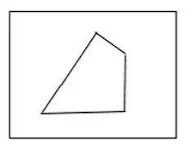
Option 1 (image_1): This figure contains several triangles converging at a point on the left, plus a rectangular step-notch on the upper right. The lines present do not form the specific combination of a long diagonal bottom-left edge combined with a short vertical right edge needed to trace our pentagon. The step-notch shape on the right introduces extra corners that break the pentagon's smooth right edge. The given figure cannot be cleanly traced here.
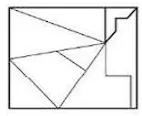
Option 2 (image_2): This figure is very similar to Option 1 — it also has converging triangular lines on the left and a step-notch cut out on the upper-right. Again, the right side of the figure has a staircase shape, which means there is no clean continuous right-side vertical edge to match the right side of our given pentagon. The embedded figure is not found here.
Option 3 (image_3): This figure shows multiple diagonal lines emanating from a single point on the left side, creating several triangles spread across the rectangle. However, the lines in this figure do not recreate the exact five-sided boundary of the given pentagon — particularly, the short top edge and the combination of the diagonal with the closed bottom do not align with any segment grouping in this figure.
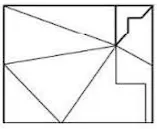
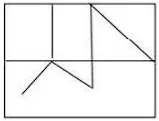
Option 4 (image_4) — The Correct Answer: This figure contains:
- A vertical line dividing the rectangle roughly in the middle.
- On the left half: two diagonal lines that form an X-like or triangular pattern from the center-left area.
- On the right half: a large diagonal line going from the upper middle toward the lower right.
- A horizontal line running across the middle of the figure.
When we carefully trace within this figure, we can identify the given pentagon formed by the following existing lines:
- The long diagonal line in the lower-left region (bottom-left side of pentagon ✓)
- The left vertical boundary of the figure (left side of pentagon ✓)
- The top portion of the central vertical line (top side of pentagon ✓)
- A diagonal line going to the upper right (the top-right slant of the pentagon ✓)
- The horizontal line at the bottom closing the shape (bottom side of pentagon ✓)
All five sides of the given irregular pentagon can be perfectly traced using only the existing lines present in Option 4, without adding any new line. The shape appears in its correct original orientation.
Step 4: Conclusion
The given irregular pentagon is successfully embedded — hidden as a sub-figure — within Option 4. The key distinguishing feature is that Option 4 contains a long diagonal line in its lower region and an upper-right slanting line that together replicate the exact boundary of the given five-sided figure, making Option 4 the correct answer.
Access expert-curated educational resources and study materials—completely free.
Create, conduct, and manage professional online assessments with Mindyard. Perfect for teachers and institutes.
Copyright © 2026 Mindyard. All Rights Reserved.