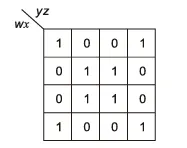
Given the following Karnaugh Map for a Boolean function F(w,x,y,z)
Solution :
The correct options/answers are:
1.
2.
Step-by-Step Analysis of the Karnaugh Map (K-Map):
Based on the provided K-map image, the map corresponds to a 4-variable Boolean function where:
- The rows represent combinations of in the standard Gray code sequence: , , , and .
- The columns represent combinations of in the sequence: , , , and .
Looking at the values in the grid, we identify the cells containing 1s:
- Row : 1s are in columns and .
- Row : 1s are in columns and .
- Row : 1s are in columns and .
- Row : 1s are in columns and .
Grouping the 1s to simplify the Boolean expression:
1. Grouping the Center 1s (Quad group in the middle):
The four cells at the center are .
- Across rows and , changes from 0 to 1 (eliminated), and remains constant at 1 ( is kept).
- Across columns and , changes from 0 to 1 (eliminated), and remains constant at 1 ( is kept).
Combining these gives the term: .
2. Grouping the Corner 1s:
The four corners of the K-map contain 1s at .
If we simplify the corner group directly:
- Across the top row () and bottom row (), changes from 0 to 1 (eliminated), and remains constant at 0 ( is kept).
- Across the leftmost column () and rightmost column (), changes from 0 to 1 (eliminated), and remains constant at 0 ( is kept).
Thus, the corner group simplifies to: .
Combining the center and corner groups yields the fully minimized expression:
Alternative Expression Formulation:
If we write the four corner cells individually as sum-of-minterms instead of simplifying them together, we get:
- Cell (00, 00) =
- Cell (10, 00) =
- Cell (00, 10) =
- Cell (10, 10) =
Adding these individual corner minterms along with the simplified center term yields the alternative representation:
Completely free for students. Educators & coaching institutes get 2 months free Pro trial to create tests.
Access unlimited practice questions, detailed step-by-step solutions, and exam study materials — completely free for students.
Create and conduct professional online assessments with AI question generation, tab proctoring, and comprehensive batch management.
A comprehensive CUET UG Mathematics Question Paper with Solutions – 2 June 2023 (Shift 3) designed to help students practice and understand the actual CUET exam pattern. This paper covers important topics from Algebra, Calculus, Coordinate Geometry, Probability, Statistics, Matrices, Determinants, and Vectors, featuring a balanced mix of conceptual, numerical, and application-based questions. Detailed solutions are provided to strengthen problem-solving skills, improve conceptual clarity, and enhance calculation accuracy. Based on the CUET syllabus and previous year exam trends, this paper is ideal for practice, revision, self-assessment, time management, previous year analysis, and final preparation for upcoming CUET UG Mathematics examinations.
A comprehensive CUET Accountancy Question Paper – 20 June 2023 (Shift 2) designed to help students practice and analyze previous year exam patterns for effective CUET preparation. This paper covers important topics including Accounting for Partnership Firms, Company Accounts, Financial Statements Analysis, Cash Flow Statements, Accounting Ratios, and Fundamental Accounting Principles. It features a balanced mix of conceptual, numerical, and application-based questions to strengthen accounting concepts, improve calculation accuracy, and enhance problem-solving skills. Based on the CUET exam structure and syllabus, this paper is ideal for practice, revision, self-assessment, time management, previous year analysis, and final preparation for upcoming CUET Accountancy examinations.
Copyright © 2026 Combe Labs Private Limited. All Rights Reserved.