How many of the following are aromatic compounds?
Correct Answer :
Solution :
The correct answer is 5.
To determine how many of the given compounds are aromatic, we apply Hückel's Rule of Aromaticity. According to Hückel's rule, a cyclic, planar, and fully conjugated molecule is classified as:
1. Aromatic if it possesses delocalized π-electrons (where ).
2. Antiaromatic if it possesses delocalized π-electrons (where ).
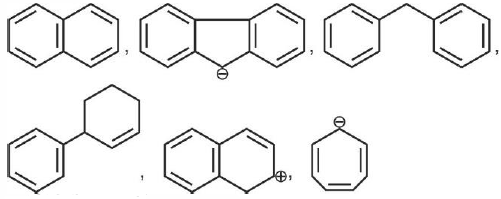
Let us analyze each of the six compounds visible in the provided image from left to right, top to bottom:
1. Naphthalene (First compound in the top row):
This molecule consists of two fused benzene rings. It is planar, cyclic, and fully conjugated. The total number of conjugated π-electrons is 10. Since
(which satisfies the rule with ), naphthalene is aromatic.
2. Fluorenyl Anion (Second compound in the top row):
This structure consists of two benzene rings fused to a central five-membered ring containing a negative charge (lone pair). The negative charge resides on a carbon atom that undergoes hybridization change from sp3 to sp2 to allow complete delocalization throughout the cyclic system. The total number of conjugated π-electrons is 14 (12 from the double bonds and 2 from the carbanion). Since
(which satisfies the rule with ), the fluorenyl anion is aromatic.
3. Diphenylmethane (Third compound in the top row):
This molecule contains two benzene rings linked by a non-conjugated sp3 methylene (-CH2-) bridge. Since the two benzene rings themselves are independently aromatic (each having a planar cyclic system with 6 π-electrons, satisfying for ), the compound contains aromatic rings and is classified as aromatic.
4. Cyclohexenylbenzene (First compound in the bottom row):
This compound features a benzene ring substituted with a cyclohexene ring. The benzene ring remains intact as a fully conjugated cyclic system containing 6 π-electrons. Since it contains a benzene ring, the compound is aromatic.
5. Dihydronaphthalenyl Cation derivative (Second compound in the bottom row):
This molecule contains a benzene ring fused to a partially unsaturated cationic six-membered ring. The benzene portion of the molecule contains 6 π-electrons in a cyclic conjugated system, making the compound aromatic.
6. Cycloheptatrienyl Anion (Third compound in the bottom row):
This is a seven-membered ring with three conjugated double bonds and a negative charge (lone pair). The total number of π-electrons participating in conjugation is:
.
Since 8 is a multiple of 4 (matching the rule for ), this fully conjugated planar system is antiaromatic.
Conclusion:
Out of the 6 compounds, 5 are aromatic, and 1 (cycloheptatrienyl anion) is antiaromatic.
Access expert-curated educational resources and study materials—completely free.
Create, conduct, and manage professional online assessments with Mindyard. Perfect for teachers and institutes.
Copyright © 2026 Mindyard. All Rights Reserved.