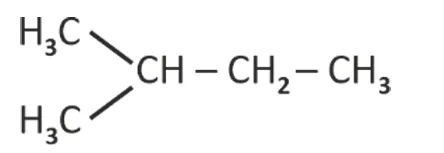
How many products (including stereoisomers) are expected from monochlorination of the following compound?
Correct Answer :
6
Solution :
The correct option is 6.
Step-by-Step Analysis:
1. Identification of the Reactant Compound:
From the given image, the molecular structure of the compound is:
(H3C)2CH - CH2 - CH3
This compound is 2-methylbutane (also known as isopentane). Let us number the carbon chain starting from the left methyl group to the right ethyl group to evaluate the positions of substitution:
There are four constitutionally distinct positions (types of hydrogen atoms) where a chlorine atom can substitute a hydrogen atom:
2. Detailed Evaluation of Monochlorination Products:
Position A: Substitution at C1 (either of the two equivalent left-end methyl groups)
Substituting a hydrogen atom at the C1 methyl group gives:
Cl-CH2 - CH(CH3) - CH2 - CH3 (1-chloro-2-methylbutane)
In this product, the C2 carbon atom (the CH carbon) is bonded to four different groups:
1. Hydrogen atom (-H)
2. Methyl group (-CH3)
3. Chloromethyl group (-CH2Cl)
4. Ethyl group (-CH2CH3)
Since it contains one chiral center, this product exists as a pair of enantiomers (d- and l-isomers).
Number of stereoisomers from this position = 2 (R and S forms)
Position B: Substitution at C2 (the CH carbon)
Substituting the hydrogen atom at the C2 carbon gives:
(CH3)2C(Cl) - CH2 - CH3 (2-chloro-2-methylbutane)
In this product, the C2 carbon is bonded to two identical methyl groups. Thus, there are no chiral centers present in this molecule, and it is achiral.
Number of stereoisomers from this position = 1
Position C: Substitution at C3 (the CH2 carbon)
Substituting a hydrogen atom at the C3 carbon gives:
(CH3)2CH - CH(Cl) - CH3 (2-chloro-3-methylbutane)
In this product, the C3 carbon (the CHCl carbon) is bonded to four different groups:
1. Hydrogen atom (-H)
2. Chlorine atom (-Cl)
3. Methyl group (-CH3)
4. Isopropyl group (-CH(CH3)2)
Since it has one chiral center, this product exists as a pair of enantiomers (d- and l-isomers).
Number of stereoisomers from this position = 2 (R and S forms)
Position D: Substitution at C4 (the right-end methyl group)
Substituting a hydrogen atom at the C4 methyl group gives:
(CH3)2CH - CH2 - CH2-Cl (1-chloro-3-methylbutane)
In this product, there are no chiral centers, so the molecule is achiral.
Number of stereoisomers from this position = 1
3. Calculation of the Total Number of Products:
Summing all the possible monochlorinated products including stereoisomers:
Therefore, a total of 6 products (including stereoisomers) are formed during the monochlorination of the given compound.
Access expert-curated educational resources and study materials—completely free.
Create, conduct, and manage professional online assessments with Mindyard. Perfect for teachers and institutes.
Copyright © 2026 Mindyard. All Rights Reserved.