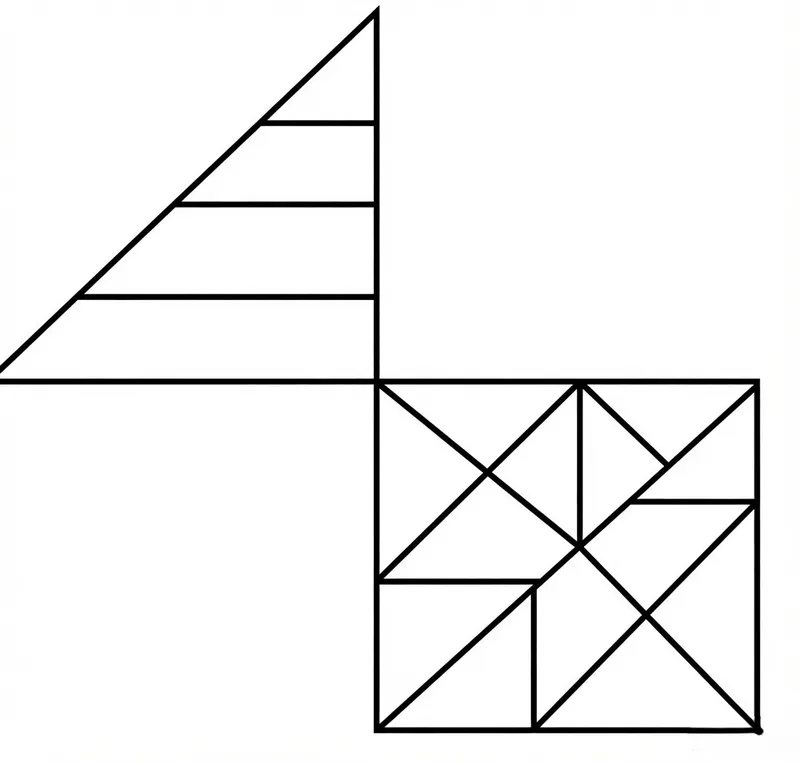
How many triangles are there in the figure given below?
Correct Answer :
10
Solution :
To find the total number of triangles in the given figure, we can divide the figure into two main independent sections: the upper-left triangular section and the lower-right square section. Since these two sections only touch at a single vertex, no new triangles are formed by combining them.
Step 1: Count the triangles in the upper-left section
Let the topmost vertex of this section be T. The vertical line on the right and the sloping line on the left form a series of nested triangles, capped by horizontal parallel lines.
From top to bottom, each horizontal line forms a new triangle with the vertex T:
Step 2: Count the triangles in the lower-right square section
By systematically identifying the individual non-overlapping triangles and the larger combined triangles within the partitioned square, we find:
Step 3: Calculate the total number of triangles
Summing the triangles from both sections:
Therefore, the correct option is 10.
Access expert-curated educational resources and study materials—completely free.
Create, conduct, and manage professional online assessments with Mindyard. Perfect for teachers and institutes.
Copyright © 2026 Mindyard. All Rights Reserved.