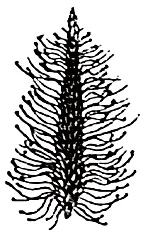
Identify the correct description about the given figure:
Correct Answer :
Wind pollinated plant inflorescence showing flowers with well exposed stamens.
Solution :
The correct option is: Wind pollinated plant inflorescence showing flowers with well exposed stamens.
Detailed Explanation:
The given diagram represents a classic wind-pollinated (anemophilous) plant inflorescence. In wind-pollinated species, flowers exhibit specific adaptations to maximize the chances of successful pollination via wind currents:
1. Well-Exposed Stamens: As visible in the diagram, there are numerous long, thread-like structures projecting outwards in all directions from the central axis. These represent stamens with long, flexible filaments. This exposure ensures that the pollen grains can be easily caught by wind currents and dispersed into the air.
2. Light and Non-sticky Pollen: These plants produce massive quantities of light, dry, and non-sticky pollen grains so that they can be carried over long distances by the wind.
3. Compact Inflorescence: Flowers are often packed closely together to form a dense inflorescence (such as the tassel of a corn plant) to facilitate efficient collective release of pollen grains.
Analysis of Incorrect Options:
• Water pollinated flowers showing stamens with mucilaginous covering: Water-pollinated (hydrophilous) plants generally have flowers that remain submerged or float at the water surface, and their pollen grains are coated with a slimy mucilage to protect them from wet environments. The diagram shows an aerial inflorescence adapted for wind dispersal, not water.
• Cleistogamous flowers showing autogamy: Cleistogamous flowers are bisexual flowers that never open, forcing self-pollination (autogamy) to occur internally. The open, outward-protruding stamens shown in the figure are characteristic of chasmogamous, wind-pollinated flowers designed for cross-pollination.
• Compact inflorescence showing complete autogamy: A compact inflorescence with highly exposed stamens is an adaptation for wind-pollination (which typically leads to geitonogamy or xenogamy), not complete autogamy (self-pollination within the same flower).
Access expert-curated educational resources and study materials—completely free.
Create, conduct, and manage professional online assessments with Mindyard. Perfect for teachers and institutes.
Copyright © 2026 Mindyard. All Rights Reserved.
 Set - 3-1782888548748.webp)